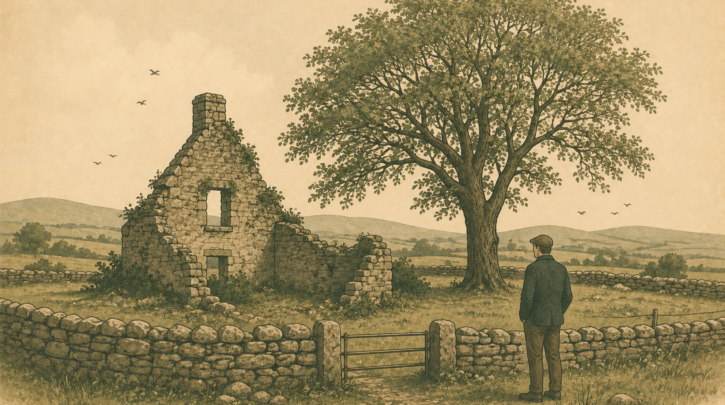

The satnav says you have arrived, and there is — a lane, a few fields, a farmhouse or two, perhaps a ruin with an ash tree growing through it. This is the townland: not a destination in any tourist sense, and one of the most powerful places you will ever stand.
Here is what actually happens on a townland visit — how to find the right fields, read the graveyard, knock the right doors, and come away with more than photographs.
Before You Go: Convert the Records to a Map
A townland visit is navigation by nineteenth-century paperwork. From Griffith’s Valuation, take the family’s map reference and pull the corresponding historic Ordnance Survey sheet on the free overlay viewers — the holding’s outline over today’s satellite image, usually with the house plot marked. Print it. Mobile coverage in rural Ireland is a rumour, and the paper map in your hand is also your introduction: nothing explains your presence on a farm lane faster.
Not sure which record to look for first?
Get the Irish Genealogy Starter Checklist — the ten records to find first, and exactly which free database holds each one.
Reading the Ground
- Houses move; plots persist. The cottage on the Griffith’s plot may be a roofless gable in a paddock — rural Ireland rebuilt beside, not on top of, the old houses. The ruin fifty metres from the modern bungalow is often exactly what you came for.
- Field boundaries are ancient. The hedges and stone walls largely follow the valuation-era lines — walking the boundary of the family holding is genuinely walking the family’s ground.
- The micro-landmarks survive: the well, the mass path, the standing stone in the corner field — features the old maps mark and locals still name. Ask for them by name and watch doors open.
The Graveyard, Done Properly
Find the burial grounds for both the civil parish and the Catholic parish — they may differ, and older burials often lie in a disused medieval yard rather than beside the current church. Then work it like a researcher: photograph every stone of the surname (and the in-law surnames from your tree), including the broken and flat ones; check the online memorial-transcription projects beforehand so you arrive with target names; and remember the silence is also evidence — pre-twentieth-century graves of the poor were commonly unmarked, so an absent headstone disproves nothing. The parish’s burial registers and the death registrations carry what the stones don’t.
Knocking on Doors: The Etiquette That Works
- Start at the pub, the shop, or the farm gate — not the front door. State the surname and the errand in one sentence: “My people were Kellys from this townland — I’m trying to find where the old house stood.” Rural Ireland’s genealogical memory is extraordinary and freely given to the polite.
- Lead with the paper: the one-page family summary and the old photograph do the talking. You are instantly a person with people, not a stranger with questions.
- Accept the tea. The information arrives in the second cup — who farms the land now, which family “has the graves,” the cousin in the next parish “who has all that.”
- Ask permission for fields, always. Every field is someone’s working land; permission is virtually always granted and the asking is the point — frequently the landowner walks with you, which is when the stories come.
Manage the Feelings (Yes, Really)
Veterans of this visit report the same ambush: the matter-of-fact morning — maps, hedges, gravestones — and then a moment, usually small, that lands like a wave: the surname on a shop front, the view from the door-stone, an old neighbour saying your great-grandmother’s first name unprompted. Build quiet time into the townland day. This is not sightseeing, and it does not feel like it.
Bring Something Home Besides Photos
- GPS-mark the house site, the graves, the boundaries — future researchers of your family will bless you.
- Record the conversations (with permission) — the local pronunciation of the townland alone is worth preserving.
- Collect the contacts: the farmer, the local historian, the cousin-of-a-cousin — the visit’s real yield is a live connection to the place.
- And write it up within the week, while the details are wet — then feed every new name into the research, because the townland always sends you home with homework.
Frequently Asked Questions
Can I just show up at my ancestral townland unannounced?
Yes — townlands are public lanes and open country, and the etiquette above is designed exactly for the unannounced visit. Advance contact improves the odds of meeting the right people, but serendipity is half this tradition.
What if the family house is gone entirely?
Stand on the plot anyway — the Griffith’s map puts you within metres, the field shapes are the same, and the view is the view they had. Visitors consistently report the empty site moves them as much as any surviving building.
Is it odd to photograph strangers’ farms and graves?
Not when explained — which is the rule: explain first, photograph second. Graveyards are public; fields need a word with the owner; people need asking. The surname is your licence — use it early in every conversation.
The Field at the End of the Records
Every certificate and census line was always pointing here — a real place with weather and cattle and your name in its memory. Plan it with the trip guide, walk it slowly, and accept the tea.
Want the shortcut? Grab the free Irish Genealogy Starter Checklist — the ten records to find first, and exactly which free database holds each one.