
“My grandmother was Irish — does that mean I can get a passport?” It is the most asked question in Irish genealogy, and the honest answer is: quite possibly, but it depends on details most family stories leave out.
This guide walks every pathway to Irish citizenship — descent through a parent, descent through a grandparent, the great-grandparent edge case, naturalisation, and the discretionary “Irish associations” route — so you can place yourself on the map before spending a cent on certificates.
Build Your Evidence Base With DNA Testing. Before gathering documents for an Irish citizenship application, many researchers use DNA testing to confirm family connections and identify living Irish relatives who may hold records. AncestryDNA has the largest database of users with Irish-American ancestry, while MyHeritage DNA is the strongest option for connecting with relatives still in Ireland. Neither result proves citizenship eligibility on its own, but both can open doors to records and family knowledge that strengthen an application. → AncestryDNA | MyHeritage DNA
Not sure which record to look for first?
Get the Irish Genealogy Starter Checklist — the ten records to find first, and exactly which free database holds each one.
Start With One Question: Who Was Born on the Island of Ireland?
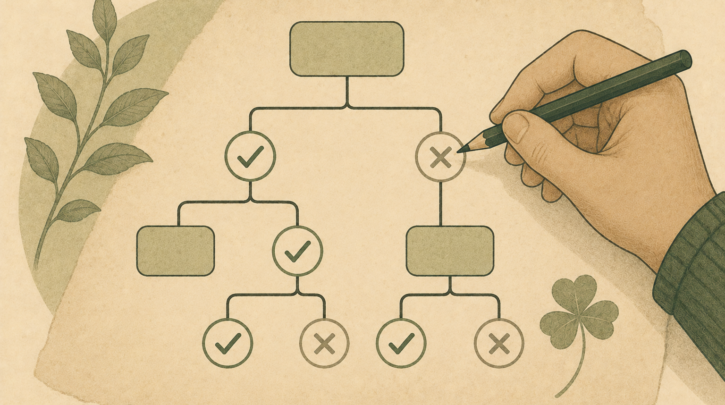
Everything in Irish citizenship eligibility hangs on identifying your nearest ancestor born on the island of Ireland — Republic or Northern Ireland, it makes no difference. Find that person in your family tree and you have found your pathway. Here is the complete map:
Pathway 1: You were born on the island of Ireland
If you were born in Ireland before 1 January 2005, you are an Irish citizen, full stop. If you were born there in 2005 or later, your citizenship depends on your parents’ citizenship or residency history at the time of your birth — a 2004 referendum changed the birthright rule.
Pathway 2: A parent born in Ireland
You are automatically an Irish citizen and can apply directly for a passport with the documentary chain — no registration required. The complete descent guide covers the document specifics.
Pathway 3: A grandparent born in Ireland
You are entitled to citizenship through the Foreign Births Register — entitled meaning the State cannot refuse you if your documents prove the chain. This is the main road for the diaspora. See exactly how the grandparent route works.
Pathway 4: A great-grandparent born in Ireland
Only viable if your parent registered on the FBR before you were born. If they did not, registration is closed at your generation — though read the great-grandparent guide before giving up, because the chain rule surprises people in both directions.
Pathway 5: Naturalisation
The residence route: broadly five years of reckonable residence in Ireland within the last nine. No ancestry required. Worth knowing about mainly as the comparison point — descent vs naturalisation, compared honestly.
Pathway 6: Naturalisation by Irish Associations
The discretionary route for people with real Irish connections that fall outside the strict descent rules — typically a great-grandparent link plus demonstrated ties to Ireland. The Minister for Justice decides case by case, published guidelines apply, and approval is genuinely uncommon. Treat it as a long shot, not a plan.
The Details That Decide Edge Cases
Adoption
Legally adopted children stand in the same position as biological children for citizenship purposes. An adopted parent’s Irish birth opens the same pathways; the documentary chain simply includes the adoption order.
Marriage to an Irish citizen
Marriage does not confer citizenship by itself — that route was abolished decades ago. Spouses of Irish citizens use a gentler naturalisation track (three years of residence rather than five), but residence in Ireland is still required.
Your grandparent naturalised as Irish (was not born there)
The FBR entitlement flows from a grandparent born on the island of Ireland. A grandparent who became Irish by naturalisation generally does not open the grandparent route for you unless your parent was born after that naturalisation — one of the genuinely tricky corners where professional advice earns its fee.
Timing of births and registrations
Citizenship through the FBR begins on the date of registration. Children born before a parent’s registration cannot claim through it; children born after can. If you are planning a family and a future generation’s eligibility matters to you, register first.
The Facts That Decide Borderline Cases
Before consulting anyone — or concluding anything — gather these specific facts. They are what every borderline determination turns on:
- Exact birthplaces and dates for the relevant ancestor and every linking generation — from documents, not memory. “Born in Ireland around 1900” becomes a pathway only when it becomes “born in Drumshanbo, County Leitrim, 14 March 1899.”
- Any FBR registration history in the family, with dates. A registration you never knew about can open a chain; a registration dated after a birth can close one.
- Adoption orders where they exist — they belong in the chain as the legal link they are.
- Naturalisation history of the Irish-born ancestor in their destination country. It rarely affects the descent claim, but the dates occasionally matter in older cases, and the naturalisation file itself is a goldmine of corroborating detail.
- Marriage dates relative to births, because they determine which surnames appear on which certificates — the raw material of the name-matching exercise.
What Eligibility Does Not Depend On
Clearing the folklore out of the way, none of the following has any bearing on your entitlement:
- Speaking Irish — there is no language requirement on any descent route.
- Having visited Ireland — residence and visits are irrelevant to descent claims (they matter only for naturalisation routes).
- An Irish surname — the chain runs through certificates, not surnames; a Kowalski with a Galway grandmother outranks a Murphy without one.
- DNA ethnicity percentages — legally weightless, however satisfying the pie chart.
- Religion — civil registration is the whole game; the law has no denominational memory.
Three Worked Examples
Boston: grandmother born in Galway
Sarah’s grandmother was born in Galway in 1931 and emigrated at nineteen. Sarah’s mother was born in Boston; Sarah too. This is the textbook Pathway 3 case: Sarah’s mother was automatically an Irish citizen (child of an Irish-born parent), making Sarah entitled to register on the FBR. Her document chain is the standard three generations — grandmother’s Galway birth certificate, mother’s Boston birth and marriage certificates, Sarah’s own — and nothing about her mother never having held an Irish passport matters at all.
Sydney: great-grandfather from Cork, no registrations anywhere
Liam’s great-grandfather left Cork in 1902. Neither Liam’s grandfather nor his mother ever registered on the FBR. Pathway 4 is therefore closed to Liam — the chain rule fails at his mother’s generation. His realistic options: a naturalisation-by-associations application if his ties to Ireland go beyond ancestry (his do not, yet), or supporting his mother’s eligibility — except her own claim fails too, since her qualifying ancestor is a great-grandparent from her perspective as well. The honest advice for Liam’s family: the registration era for this line has passed. The heritage has not.
Toronto: mother born in Belfast
Aoife’s mother was born in Belfast in 1968. Northern Ireland counts fully, and a parent born on the island makes Aoife an automatic citizen — Pathway 2. No FBR, no registration queue: Aoife’s task is purely assembling certificates (her mother’s GRONI birth certificate, her own birth certificate) and applying directly for the passport. Half her document-gathering time, none of the processing wait.
While You Check Eligibility, Start the Records Habit
Whichever pathway turns out to be yours, the raw material is identical: civil certificates and the family facts that locate them. The fastest applicants are the ones who treat eligibility-checking and record-gathering as one project — confirming the Irish birth through IrishGenealogy.ie or the 1901/1911 census, then ordering the certificates the same week. The genealogy is not a detour from the citizenship application; it is the application.
A Quick Self-Assessment
- Identify your nearest ancestor born on the island of Ireland.
- If that person is you or a parent — you are a citizen already; gather certificates and apply for a passport.
- If a grandparent — you are FBR-eligible; start the document chain.
- If a great-grandparent — check whether your parent registered before your birth; if not, weigh the associations route with cold eyes.
- If none of the above — the ancestry routes are closed, but residence-based naturalisation remains.
Frequently Asked Questions
What makes someone automatically an Irish citizen versus entitled to register?
Birth on the island (pre-2005) or birth abroad to an Irish-born parent makes you a citizen automatically. A grandparent connection makes you entitled — citizenship is yours for the claiming, but it only takes effect when you register on the FBR.
Can I claim through my Irish-born grandparent if my parent never had any Irish documents?
Yes. Your parent’s paperwork status is irrelevant to the grandparent route — what matters is proving the biological/legal chain: grandparent born in Ireland, parent born to them, you born to your parent. Your parent never needs to have claimed anything.
Does it matter whether my Irish ancestor was my mother’s side or father’s side?
No. Irish law treats maternal and paternal lines identically for descent claims at every generation.
I have Irish ancestry on multiple lines — does that help?
It gives you options rather than additive strength. Pick the line with the cleanest, closest connection — ideally the most recent Irish-born ancestor with the most orderly paper trail — and build your application on that single chain.
Is there an age limit on claiming Irish citizenship by descent?
None in either direction. Adults of any age register on their own behalf, and there is no deadline by which a claim must be exercised — an entitlement through your grandparent waits patiently until you act on it. The only clock in the system is the one that matters for your descendants: your registration date versus their birth dates.
Can I apply for my minor children at the same time?
The timing rule answers this one strictly. Children born after your FBR registration can be registered through you — that is the chain working as designed. Children born before your registration cannot claim through you, and their own direct claim fails too: from their perspective the Irish-born ancestor is a great-grandparent, which requires you to have registered before their birth — the very thing that did not happen. For families mid-way through having children, the practical sequence writes itself: the parent registers first, and the entitlement flows to every child born afterward.
Know Your Pathway? Here’s the Next Step
Once you know which route is yours, the work becomes documentary. Start with the FBR document checklist if you are on the grandparent road, and the Irish civil records guide to source the Irish-side certificates.