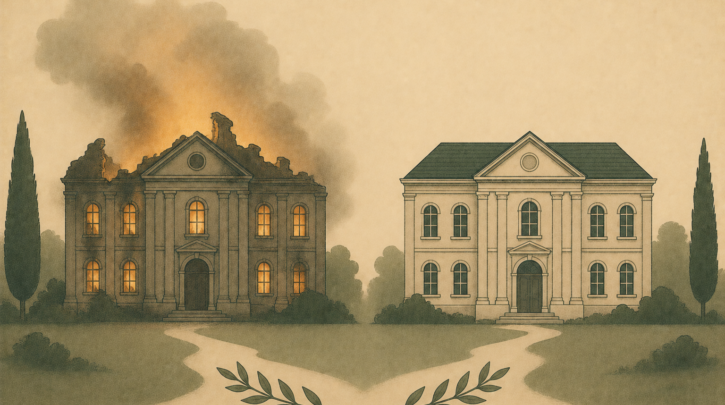

On 30 June 1922, in the opening days of the Irish Civil War, the Public Record Office at the Four Courts burned — and with it, seven centuries of Ireland’s documented memory. It is the disaster every Irish researcher has heard of, usually in the exaggerated form: “all the records were destroyed.”
The truth is both sadder and far more hopeful. This guide is the honest accounting: precisely what burned, what never did, the workaround for every major loss — and the remarkable digital project now resurrecting pieces of the archive itself.
What Happened
The Public Record Office of Ireland, founded 1867, occupied a building beside the Four Courts in Dublin — the strongroom holding the accumulated legal, administrative, and ecclesiastical records of the island. When anti-Treaty forces occupying the Four Courts were shelled at the war’s outbreak, fire and a munitions explosion gutted the record treasury. Most of its contents were destroyed in an afternoon; charred fragments fell on Dublin for days.
Not sure which record to look for first?
Get the Irish Genealogy Starter Checklist — the ten records to find first, and exactly which free database holds each one.
What Was Lost
- The nineteenth-century censuses — with a caveat the legend omits: 1861–1891 had already been destroyed by government order (some pulped in wartime paper drives); the fire took most of what remained of 1821–1851. Either way, the century’s censuses are gone bar fragments.
- Pre-1858 wills and testamentary records — the originals of centuries of probate, a profound loss for property and family reconstruction.
- About a thousand Church of Ireland parish registers — those deposited for safekeeping under an 1875 act burned with the building; registers retained locally (and copies made before deposit) survived.
- Court, administrative, and medieval records — the deep archive of governance back to the thirteenth century, including material with no genealogical purpose and no replacement.
What Survived — the List That Saves Your Research
The records modern genealogy actually runs on were, almost without exception, never in the building:
- Civil registration — intact. Births, marriages, and deaths lived with the General Register Office, not the PRO. Every certificate a citizenship application needs survived in full — the civil records guide.
- Catholic parish registers — intact. Kept in the parishes, never deposited; later microfilmed and now free online — the registers guide.
- The 1901 and 1911 censuses — intact. Still in administrative custody in 1922; now the free cornerstone at the National Archives — the census guide.
- Griffith’s Valuation and the valuation books — intact. Valuation Office records, separately housed; the census substitute the century needed — the Griffith’s guide.
- The Tithe Applotment books, the Registry of Deeds (1708 onward), and transcribed will calendars and abstracts — the land, property, and probate workarounds, all outside the fire’s reach.
The Workarounds, Loss by Loss
- Lost censuses → Griffith’s + Tithes: the valuation pair brackets the famine decades with household-head listings — not full censuses, but the canonical substitute method.
- Lost wills → calendars and abstracts: annual probate calendars survive from 1858, and generations of genealogists abstracted older wills before the fire (the Betham abstracts most famously) — the index of the burned cabinet, often with the essentials preserved.
- Lost Church of Ireland registers → the RCB Library and local survivals: roughly a third of registers escaped (never deposited, or copied) — the Representative Church Body Library coordinates what exists; civil registration from 1845 covers the marriages.
- Lost court and estate context → the Registry of Deeds and landed-estate papers: property transactions, leases, and marriage settlements back to 1708, untouched — the advanced researcher’s replacement for much that burned.
The Resurrection: Ireland’s Virtual Record Treasury
A century after the fire, the most heartening development in Irish records: the Virtual Record Treasury of Ireland, launched on the disaster’s centenary, is digitally reconstructing the burned archive from duplicates, transcripts, calendars, and copies scattered through libraries worldwide — substitute sources for tens of millions of words already free online, including recovered census fragments and probate material. The fire’s losses were real; their permanence, it turns out, was overstated. Check the Treasury whenever this guide says “destroyed” — the word keeps becoming slightly less true.
Frequently Asked Questions
Were Irish birth, marriage, and death records destroyed in 1922?
No — none of them. Civil registration was held by the General Register Office, a separate institution in a different location. The complete registers from 1864 (1845 for non-Catholic marriages) survive, which is why citizenship-by-descent applications are unaffected by the fire.
So why is my research stuck, if the key records survived?
Usually geography, not destruction: the missing fact is almost always the townland or parish, and the cure is method — the tracing sequence — rather than mourning. The fire is real but is the explanation for far fewer brick walls than it gets blamed for.
Which researchers are genuinely affected by the fire?
Those with Church of Ireland lines whose parish’s deposited registers burned; anyone needing pre-1858 original wills; and deep-history projects into the medieval and early-modern administration. For mainstream Catholic family reconstruction from the 1820s onward, the working record set is essentially intact.
What was the worst single loss?
By scholarly consensus, the irreplaceable medieval and early-modern administrative archive — centuries of Ireland’s governance with no duplicates anywhere. Genealogy lost much; history lost more.
Grief, Correctly Aimed
The 1922 fire deserves its place in Irish memory — but as a specific tragedy, not a universal excuse. Your family’s baptisms are in the parish chest’s microfilm, their certificates in the GRO, their townland in Griffith’s, their household in 1901 — and pieces of what truly burned are returning, scan by scan, a century late. Go find them.
Want the shortcut? Grab the free Irish Genealogy Starter Checklist — the ten records to find first, and exactly which free database holds each one.