
Before the State counted the Irish, the Church christened them. For the decades before civil registration — and for the great majority of the population — the Catholic parish register is the only document on earth recording that your ancestor was born, married, and belonged somewhere.
This guide covers the registers end to end: what they contain, the free digitised collections, the coverage realities by region, and how to read a crabbed Latin baptism like a researcher.
What the Registers Are
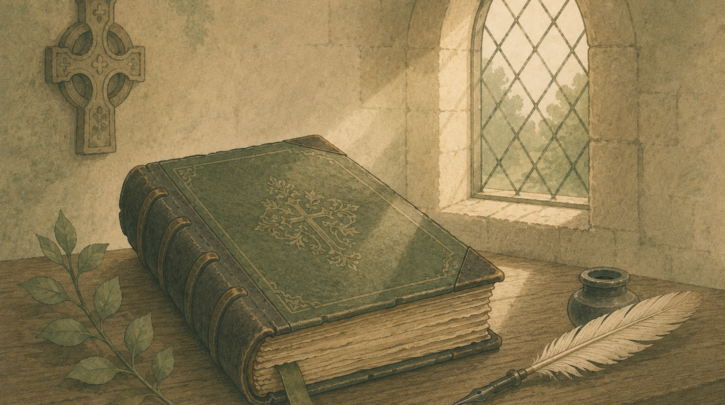
Parish priests recorded baptisms and marriages (burials more rarely and patchily) in bound registers kept at the parish. Coverage start dates vary enormously: city and eastern parishes often begin in the 1700s, while many western and poorer rural parishes open only in the 1820s–1850s — meaning the registers’ horizon, not 1864, is the true back wall of most Irish family trees. The originals largely remain with the Church; what transformed research is that the National Library of Ireland microfilmed almost all Catholic registers up to roughly 1880 and has published the images free online.
Not sure which record to look for first?
Get the Irish Genealogy Starter Checklist — the ten records to find first, and exactly which free database holds each one.
The Free Collections, Mapped
- NLI Registers (registers.nli.ie): the headline source — browseable images of nearly every Catholic parish’s registers to about 1880, organised by parish. Unindexed: you browse pages, which is slower and stranger and frequently wonderful.
- IrishGenealogy.ie church collections: indexed (and partly imaged) church records for Dublin, Kerry, and Cork & Ross among others — where your parish falls in the coverage, searching beats browsing. The site guide covers technique.
- RootsIreland (subscription): the county genealogy centres’ transcriptions — the largest indexed body of Catholic registers, including the post-1880 years the NLI microfilm stops short of. The standard escalation when browsing fails: rootsireland.ie.
- FamilySearch and the commercial giants: overlapping indexes of varying quality — useful as additional search angles on the same underlying registers.
Reading a Baptism Entry
Most Catholic registers are in Latin — formulaic Latin, learnable in an evening. A typical entry: “Baptisavi Patritium, filium legitimum Joannis Kelly et Mariae Flanagan de Cloonfad. Sponsoribus: Thoma Kelly, Brigida Flanagan.” Decoded: Patrick, lawful son of John Kelly and Mary Flanagan of Cloonfad townland; godparents Thomas Kelly and Brigid Flanagan. Note everything the formula carries:
- Latinised forenames: Patritius/Patrick, Joannes/John, Maria/Mary, Brigida/Bridget, Gulielmus/William, Honoria/Hanora — a one-page conversion table covers nearly everyone.
- The mother’s maiden name, always: Catholic registers record it as a matter of form — the same generational stitching the civil records provide, decades earlier.
- The townland: the de Cloonfad — residence at baptism, and frequently the detail that converts a county-level mystery into an address.
- The sponsors: godparents were overwhelmingly drawn from the two families — uncles, aunts, grandparents. Across a sibling set, the sponsor list reconstructs the extended family better than any single record.
Marriage Entries and Their Bonus Material
Register marriages give the parties, their townlands, the witnesses (siblings and cousins again), and — in later, better-kept registers — sometimes fathers’ names. Watch for the annotations: dispensations for consanguinity (“dispensatio in tertio gradu”) flag that bride and groom were already related — third-degree meaning second cousins — which is not gossip but genealogy: it tells you the two family trees intersect a fixed number of generations up.
Browsing the NLI Registers Without Losing Your Mind
- Fix the civil parish first — from a civil record’s townland via the townland guide — then map it to the Catholic parish (the two systems overlap imperfectly; a townland can sit in a Catholic parish named differently from its civil one).
- Open the parish on registers.nli.ie and note the register’s start dates and gaps — the gaps are listed, and knowing them prevents fruitless hunts.
- Estimate the target date from the civil-era records (a person marrying in 1870 aged “25” was baptised somewhere around 1840–1848), and browse outward from the estimate.
- Read every page you pass for the surname, not just the target — the siblings and cousins you collect en route are the FAN-club capital that solves the case.
- Transcribe and screenshot as you go, with frame numbers — refinding an unindexed entry is purgatory.
Church of Ireland, Presbyterian, and the 1922 Shadow
Protestant records run on different rails. Many Church of Ireland parish registers were deposited in the Public Record Office — and burned in 1922; survivals exist where copies stayed local, now coordinated through the RCB Library, and the loss is the genuine half of the records-fire legend (the full accounting here). Presbyterian registers largely remained with congregations, strongest in Ulster. And remember the civil bonus for these traditions: non-Catholic marriages register civilly from 1845, nineteen years before everyone else.
Frequently Asked Questions
Are Irish parish registers free to view online?
The core Catholic collection is — the NLI’s register images are free and open, and the IrishGenealogy.ie church indexes likewise. Subscriptions enter the picture for indexed searching of the same registers and for the post-1880 decades.
My ancestor’s baptism should exist but I can’t find it — why?
In order of likelihood: the family attended the neighbouring parish (parish-hop systematically), the register has a gap covering your years (check the listed gaps), the Latin forename fooled the eye, the estimated date is off (declared ages drift), or the parish’s registers simply start later than your target — in which case the chase moves to land and valuation records.
What does “illegitimus” in a register mean for research?
It records a child born outside marriage — in research terms, often a single-parent line where the register names only the mother. Trace the maternal family; sponsors and later civil records frequently restore what the formula withholds.
How far back can parish registers take me?
To the parish’s start date and no further — 1700s in fortunate eastern parishes, 1820s–1850s in much of the west. The register horizon is the practical limit of name-by-name Irish genealogy; beyond it lie land records, estate papers, and surname-distribution inference rather than individual ancestors.
Where the Tree Actually Grows
Civil records frame the modern family; the registers are where the eighteenth- and nineteenth-century tree actually grows, sponsor by sponsor and townland by townland. Pair them with Griffith’s Valuation — the registers name the people, Griffith’s places them on the land — and the pre-Famine family begins to surface.
Want the shortcut? Grab the free Irish Genealogy Starter Checklist — the ten records to find first, and exactly which free database holds each one.