
One Irish-born grandparent. That is the entire entry requirement for the most travelled road to Irish citizenship — a road your family qualified you for the day your grandmother or grandfather was born on the island of Ireland.
This guide covers the grandparent route end to end: why it works, the three-generation paper chain that proves it, the situations that complicate it, and how to run the process without losing months to avoidable errors.
Build Your Evidence Base With DNA Testing. Before gathering documents for an Irish citizenship application, many researchers use DNA testing to confirm family connections and identify living Irish relatives who may hold records. AncestryDNA has the largest database of users with Irish-American ancestry, while MyHeritage DNA is the strongest option for connecting with relatives still in Ireland. Neither result proves citizenship eligibility on its own, but both can open doors to records and family knowledge that strengthen an application. → AncestryDNA | MyHeritage DNA
Not sure which record to look for first?
Get the Irish Genealogy Starter Checklist — the ten records to find first, and exactly which free database holds each one.
Why a Grandparent Is the Magic Generation
Irish nationality law gives the children of Irish-born parents citizenship automatically — which means your parent, as the child of your Irish-born grandparent, was an Irish citizen from birth whether they ever knew it or not. You, born abroad to that (often unwitting) Irish citizen, inherit an entitlement: the right to become Irish by registering on the Foreign Births Register.
The distinction matters. Entitlement means the State cannot exercise discretion against you. Prove the chain with documents and registration follows. No quotas, no interviews, no residence requirements, no language test.
The Three-Generation Paper Chain
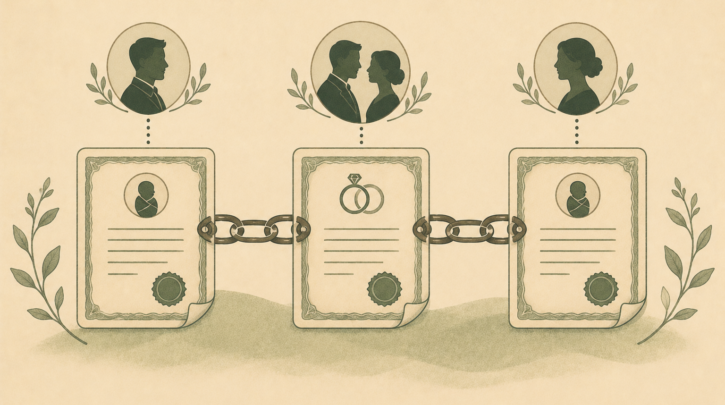
Your entire application is the documentary proof of three statements: your grandparent was born in Ireland; your parent is their child; you are your parent’s child. The standard chain:
- Generation 1 — your Irish-born grandparent: long-form Irish birth certificate, marriage certificate, and (if deceased) death certificate.
- Generation 2 — your linking parent: long-form birth certificate naming your grandparent, plus marriage certificate if names changed.
- Generation 3 — you: long-form birth certificate naming your parent, current passport or ID, proof of address, certified photographs.
Every certificate must be a certified long-form civil copy — the version showing parents’ names, which is what stitches the generations together. The full document checklist covers ordering sources, and the Irish civil records guide handles the Irish side, including pre-1900 births.
The Complications Worth Knowing About
The name maze
Irish emigrant records are a festival of variant spellings — Honora becomes Nora becomes Norah; surnames gained and lost their O’ at the registrar’s whim. Discrepancies do not sink applications, but unexplained discrepancies stall them. Where names differ across documents, supporting evidence connecting the variants belongs in your file from day one.
Northern Ireland births
Fully qualifying — the entitlement covers the whole island. The only practical difference is that certificates come from GRONI (the Northern Ireland registry) rather than the Republic’s GRO.
The grandparent who “might” have been born in Ireland
Family lore says Galway; the census says New York. Before ordering certificates, verify the birthplace through genealogy sources — our ancestry tracing guide shows how to confirm an Irish birth quickly, and emigration-era records often resolve the question in an evening.
Deceased grandparents and missing records
Death is no obstacle — the chain runs on certificates, not signatures. Genuinely missing Irish records are rarer than feared: civil registration ran from 1864, and church records reach back further. The workarounds are well established.
Running the Process Well
- Verify the Irish birth before spending money.
- Order all certificates in parallel, with two certified copies of anything hard to obtain.
- Reconcile every name and date across the chain; document explanations for variants.
- Apply online, get the witnessing exactly right, and submit one complete bundle.
- Track the post, scan everything, respond fast to any Department query.
The step-by-step FBR guide expands each stage in detail.
A Worked Example: Margaret from Sligo
Margaret Feeney is born in County Sligo in 1928 — her long-form birth certificate, ordered today from the General Register Office, shows her parents’ names and the townland. She emigrates in 1949 and marries John Walsh in Chicago in 1952; the Cook County marriage certificate documents the Feeney-to-Walsh name change. Their daughter Patricia is born in Chicago in 1955 — her Illinois long-form birth certificate names Margaret Walsh, née Feeney, as her mother. Patricia marries in 1978 (another certificate, another name change documented), and her son Michael is born in 1982, his birth certificate naming Patricia.
Michael’s FBR file is precisely those five certificates plus his own identity documents: Sligo birth, Chicago marriage, Patricia’s birth, Patricia’s marriage, Michael’s birth. Every name change is bridged by a marriage certificate; every generation names the one above. The assessor can read the family’s entire civil history in ten minutes — which is exactly the experience you are trying to create.
What the Grandparent Route Costs
- FBR application fee: roughly €270–€300 for an adult at recent rates.
- Certificates: typically €20–€25 per Irish certificate from the GRO, with US, UK, Canadian, and Australian registries charging their own fees — commonly $15–$40 each. Budget for five to seven certificates.
- Witnessing/notary: from free (some professions) to $50–$150 depending on country and provider.
- Tracked international shipping: $30–$80 each way.
- Passport fee afterward: separate, currently under €100 for a standard adult book.
A realistic all-in figure is €500–€800 for most applicants — a fraction of what residence-based migration to any EU country would cost, which is worth remembering on the days the paperwork feels heavy.
If Your Grandparent Was Born in Northern Ireland
Nothing changes legally — the entitlement is identical — but your ordering path does: birth, marriage, and death certificates for events in the six counties come from GRONI (the General Register Office for Northern Ireland) rather than the Republic’s GRO, with its own ordering system and fees. Pre-partition records for what is now Northern Ireland are part of the all-island civil registration system from 1864, so very old certificates may be obtainable from either side’s indexes; start with GRONI for post-1922 events.
Coordinating With Siblings and Cousins
Because every grandchild holds an independent entitlement, the same Generation 1 documents serve every descendant’s application. Families increasingly run the project together: one cousin orders the Irish certificates (with extra certified copies for each applicant), another handles the shared parent generation, and everyone files individually with their own Generation 3 documents. The cost per person drops, the name-variant detective work happens once, and the family tree that emerges becomes common property — often the project’s most durable output.
Verifying the Irish Birth Before You Spend a Cent
The family says Granda was born in Kerry. Before five registries receive your money, spend an evening confirming it — for free:
- Search the civil birth indexes on IrishGenealogy.ie. Historic births are indexed and, for older records, the register images themselves are viewable. Finding the entry gives you the registration district and year — everything the GRO order form wants. Our walkthrough covers the search syntax and the spelling-variant tricks.
- Cross-check the 1901 and 1911 censuses. If your grandparent was born before 1911, the census shows them in an Irish household, with age and county of birth — powerful corroboration that you have the right person. Searching takes minutes.
- Work backward from emigration records where the Irish side is foggy — ship manifests and naturalisation papers in the destination country routinely state the exact place of origin. The emigration records guide shows where to look.
An evening of free verification has saved many families from ordering certificates for the wrong John Murphy — there were, it turns out, several.
What if my grandparent’s birth was never civilly registered?
Late and missed registrations did happen, especially in the early decades of civil registration. The established fallback is the baptismal record — usually created within days of birth and accepted with supporting evidence. The parish registers guide shows how to locate it; the National Library’s digitised registers cover most Catholic parishes well into the relevant era.
Frequently Asked Questions
My grandparent emigrated as a small child — do they still count?
Completely. Birth on the island of Ireland is the entire test. Length of residence afterwards is irrelevant to your entitlement.
Can multiple grandchildren claim through the same grandparent?
Yes — every grandchild holds an independent entitlement, and siblings or cousins often coordinate certificate-ordering to share costs. Each person files their own application.
Does my parent need to register before I can?
No. The grandparent route is yours directly — your parent’s paperwork status is irrelevant. (The parent-must-register rule applies only one generation further out, at great-grandparent distance.)
How long does the grandparent route take end to end?
Realistically one to three months of document gathering plus nine to twelve months of processing for clean files. The timeline guide breaks down where the time actually goes.
Do I ever have to travel to Ireland during the process?
Not once. The FBR is a postal-and-online process from anywhere in the world — the documents travel, you do not. Many applicants nonetheless find themselves booking the trip the week the certificate arrives, for reasons no application form captures. When that urge strikes, the records you gathered double as a travel itinerary: the townland on the birth certificate is a real place, still on the map, usually still farmed by someone who knows the name.
When is professional help actually worth paying for?
For the standard three-generation chain with findable records: rarely — the process is designed for unrepresented applicants. The genuine triggers are structural: a missing generation of records, adoptions or guardianships in the chain, conflicting identities that evidence cannot bridge, or old family registrations whose effect is unclear. In those cases an hour of advice before filing beats a year of correspondence after — here is how to find the right help at the right price.
Your Grandparent Left You More Than Stories
Most people inherit photographs and a few half-remembered place names. If your grandparent was born in Ireland, they also left you a legal entitlement that survives them — one that no waiting list, lottery, or minister’s discretion can take away. The paperwork is the price; the citizenship is already yours to claim.
Not sure if you qualify? Work through every pathway in the Eligibility Guide.