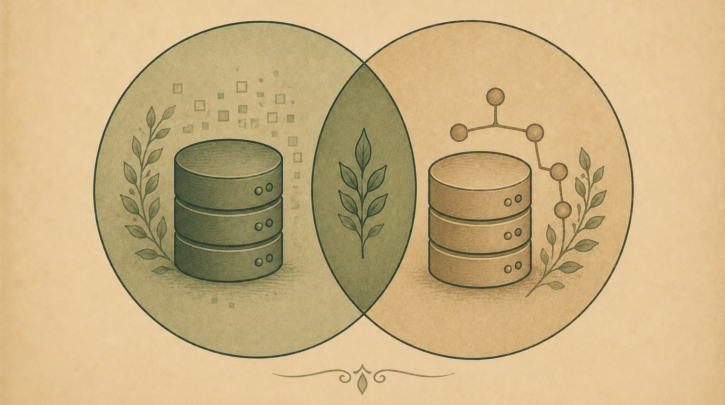

For Irish research, the AncestryDNA-versus-MyHeritage question has a clean answer — because the two services hold different halves of your family. The diaspora tested with one; Ireland and Europe lean toward the other. Choosing between them is really choosing which cousins you want to meet first.
Here is the head-to-head for Irish ancestry specifically: databases, tools, ecosystems, the verdict — and the upload strategy that quietly makes the whole dilemma optional.
The Core Difference: Where Your Relatives Are
AncestryDNA holds the largest consumer DNA database in existence, with overwhelming representation of Americans — including the tens of millions of Irish-American descendants of the emigration century. MyHeritage’s base is smaller but tilts European, with materially better penetration among testers still living in Ireland, Britain, and the continent — reinforced by years of accepting raw-data uploads from other companies. One swab company knows Boston; the other knows Ballina. Everything else in this comparison is detail on that fact.
Match Tools, Head to Head
- AncestryDNA: shared-match clustering, ThruLines tree-hypothesis hints, and the deepest integration of matches with member trees — but famously no chromosome browser, which serious segment-mappers resent.
- MyHeritage: a full chromosome browser, AutoClusters built in, Theory of Family Relativity for tree-bridging — the more technically generous toolkit, on the smaller match pool.
- For Irish work specifically: the limiting factor is almost always who tested, not the tooling — which is why the database question above outranks every feature row below it.
Records and Trees: The Ecosystem Question
A DNA match attached to a documented tree is what actually advances research, and both services wrap their tests in record subscriptions. Ancestry’s collections are the deeper ocean — particularly the US immigration and naturalisation material that anchors the emigration-side chain — while MyHeritage’s holdings plus its European tester trees frequently carry the Irish-side connections. In practice the records question mirrors the database question: destination-country depth on one side, old-world breadth on the other.
Ethnicity Estimates
Both resolve Irish ancestry credibly at the national level, and both have pushed toward regional resolution within Ireland — interesting confirmation when it echoes your documented counties, never evidence on its own. Treat the percentages as the décor of the results page; the match list is the furniture.
Side by Side
| AncestryDNA | MyHeritage DNA | |
|---|---|---|
| Database size | Largest in the industry | Large; Europe-leaning |
| Irish-American cousins | Best available | Good |
| Cousins in Ireland/UK/Europe | Good | Best available |
| Chromosome browser | No | Yes |
| Clustering / tree hints | Strong (ThruLines) | Strong (AutoClusters, Theory) |
| Records ecosystem | Deepest (US-strong) | Strong (Europe-strong) |
| Accepts uploads from rivals | No | Yes — the strategic fact |
The Verdict
Testing once, diaspora-based, building the documented tree: AncestryDNA wins — the database depth among Irish-American testers and the records integration make it the foundation test. Hunting relatives still in Ireland, or already tested elsewhere: MyHeritage wins — the European pool and the upload door make it the bridge. Both are running constant promotional pricing; neither choice is expensive enough to agonise over. AncestryDNA → | MyHeritage DNA →
Can You Use Both? (Yes — for the Price of One and a Half)
The settled strategy of Irish DNA research: test at AncestryDNA, then upload the raw data file to MyHeritage — the upload is accepted, and unlocking MyHeritage’s full DNA tools costs a modest fee rather than a second kit. One swab, both databases, both halves of the Atlantic. The reverse does not work (Ancestry accepts no uploads), which settles the testing order for anyone starting fresh. Then put the combined match list to work with the relative-finding method.
Frequently Asked Questions
Which is better for Irish ancestry, AncestryDNA or MyHeritage?
AncestryDNA for the Irish-American diaspora side and the documented-tree ecosystem; MyHeritage for matches still in Ireland and Europe. The upload strategy — Ancestry first, raw data to MyHeritage — captures both and is the standard recommendation.
Are the ethnicity results different between the two?
Somewhat — different reference panels produce different regional splits, and seeing both estimates is one of the upload strategy’s minor perks. Neither version is “wrong”; both are models, and the match list outranks them for actual research.
Do I need the subscription as well as the test?
Not for matching — matches and core tools work without one. Subscriptions buy the records and full-tree access that turn matches into documented connections; the economical pattern is a focused subscription month when the match list warrants it.
Two Databases, One Family
The Atlantic divided the family; the two databases inherited the halves. Test where the diaspora tested, upload to where Ireland tests, and let the full four-service comparison cover the specialist tools — the reunion is a matter of method now.
Mapping a citizenship claim as well as a family tree? Work through every pathway in the Eligibility Guide.