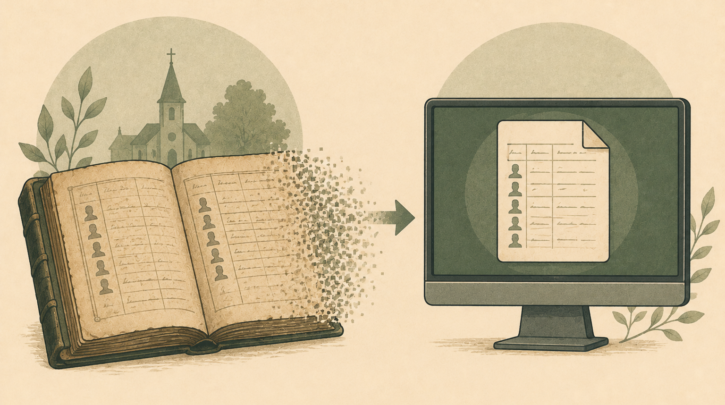

If Irish research has a front door, it is IrishGenealogy.ie — the State’s own free portal, holding the civil record indexes for the whole island and, for older events, the register images themselves. Most family mysteries that can be solved at all begin unravelling here.
This guide is the practical walkthrough: what the site holds, what the privacy thresholds hide, the search techniques that defeat Irish spelling, and how to turn a found index entry into the certificate a citizenship application needs.
What the Site Actually Holds
- Civil records — the headline collection: indexes to the island-wide civil registration of births (from 1864), marriages (from 1845 for non-Catholic, 1864 general), and deaths — with register images viewable once records pass the privacy thresholds.
- The privacy thresholds: births over 100 years old, marriages over 75, and deaths over 50 are open with images. Younger events appear in index form or not at all — for those, certified certificates from the GRO are the route.
- Church records for selected areas: indexed (and partly imaged) church registers for Dublin, Kerry, and Cork & Ross among others — a regional bonus collection, not island-wide coverage.
For parishes outside the church-records coverage, the National Library’s register images are the companion source — the parish registers guide pairs the two.
Not sure which record to look for first?
Get the Irish Genealogy Starter Checklist — the ten records to find first, and exactly which free database holds each one.
Search Technique: Defeating Irish Spelling
Irish records spell creatively — the same woman can be Honora, Hanora, Nora, and Onny across four documents, her surname gaining and losing its O’ at the registrar’s whim. Search accordingly:
- Start broad: surname plus a date range and county beats a full-name exact search every time. Narrow only when drowning in results.
- Rotate the variants: search with and without O’/Mc prefixes, and learn your surname’s standard mutations — {a(‘irish-surnames-anglicized’,’the anglicization guide’)} lists the common patterns.
- Use the mother’s maiden name field in birth searches when you have it — it is the single most powerful filter the index offers, collapsing hundreds of John Kellys into one family’s children.
- Trust ages loosely: reported ages drift years from the truth; pad every birth-year estimate by three to five years in both directions.
Reading the Register Image Like a Researcher
The image behind an index entry repays close reading. A birth registration carries the townland, the father’s name and occupation, the mother’s maiden name, and the informant — often a grandmother or aunt whose name extends the family. A marriage entry gives ages, addresses, occupations, both fathers’ names, and the witnesses — siblings and cousins hiding in plain sight. Transcribe everything; the incidental names are next month’s breakthroughs.
From Index Entry to Certified Certificate
For citizenship purposes the screen image is research, not evidence — the FBR bundle wants certified long-form certificates. The index entry you found supplies exactly what the GRO order form asks: name, year, registration district, and volume/page references. Order the certified copy citing those details and the right certificate arrives first time — the entire reason to research before ordering.
What the Site Won’t Do
- Recent records: the privacy thresholds are firm — a 1960s birth needs a GRO certificate application, not a search.
- Most church records: coverage outside the featured regions lives at the National Library and on the subscription services.
- Northern Ireland after 1922: post-partition events in the six counties belong to GRONI’s separate system; the all-island coverage applies to the pre-partition era.
- The connecting logic: the site finds records; assembling them into a proven chain remains the researcher’s craft — which is what {a(‘how-to-trace-irish-ancestry’,’the tracing method’)} is for.
A Fifteen-Minute Worked Example
Family lore: grandmother Mary Sullivan, born County Kerry around 1900. Search births, surname Sullivan, Kerry, 1895–1905 — eighty results. Add the remembered mother’s maiden name, Connor: five results. Two are Marys; one’s registration district matches the parish from a US marriage record. Open the image: Mary Sullivan, born 4 March 1899, townland of Gortacurraun, father Daniel, a fisherman, mother Margaret Connor. Fifteen minutes, one townland, and a citizenship chain’s first Irish document located — that is the site working as designed.
Frequently Asked Questions
Is IrishGenealogy.ie completely free?
Entirely — searching, viewing images, and downloading are free. It is a government service, not a freemium funnel; the only payments in the ecosystem are for certified GRO certificates when you need legal-grade copies.
Why can’t I find a birth I know happened?
In rough order of likelihood: spelling variants (rotate them), an age myth (widen the range), a privacy-threshold record (too recent for images), an event registered late or in an unexpected district, or — for the earliest years — a birth that escaped registration, in which case the baptismal register takes over.
Does it cover Northern Ireland?
For the all-island registration era before 1922, yes — events in what became Northern Ireland appear in the historic indexes. Post-1922 events are GRONI’s territory, ordered through its own system.
Can I use the register images for an FBR application?
Use them to identify the record precisely, then order the certified long-form certificate from the GRO with the index details. The application wants the registry’s certified paper; the website’s gift is making sure you order the right one once.
Advanced Index Tricks
- Search by parents alone. Leave the child’s forename blank and search births by surname plus mother’s maiden name: the result is the couple’s entire family, in registration order — the fastest sibling-reconstruction tool in Irish research, and a gift to anyone working the FAN method.
- Use registration districts as geography. Districts map onto the old Poor Law Unions; once one family record fixes your district, treat it as a filter on every later search — the right John Kelly is the one registered where his siblings were.
- Infer from the gaps. Children in rural Ireland arrived roughly every two years; a four-year gap in the sibling list suggests an infant death (check the death index) or an emigration-era move — both findable, both informative.
- Mind the late registrations. Births registered months late are indexed in later quarters — a child “missing” from their birth year often hides in the following one.
The Free-Tier Workflow: Pairing the Site With the Other Pillars
IrishGenealogy.ie is one corner of a four-source loop, and the loop is the method: a civil birth record gives a townland → Griffith’s Valuation shows the family’s holding there a generation earlier → the 1901/1911 censuses show who remained and their ages (correcting every age myth in the family) → the parish registers extend the line back past 1864 — and each new name discovered feeds back into the civil indexes. Two or three circuits of that loop is how a single index entry becomes a documented family.
When the Record Isn’t There: The Escalation Path
- Exhaust the variants and the widened date range — most “missing” records are spelling problems wearing a disguise.
- Check the adjacent registration districts — families near district borders registered where the registrar was, not where the map says they should.
- Drop to the church layer — a baptism in the NLI registers frequently survives where a civil registration was never made, especially in the system’s first decades.
- Consult the subscription indexes — RootsIreland’s county-centre transcriptions sometimes index what the free images leave unsearchable.
- Then — and only then — consider that the event happened elsewhere: the emigration-side records (manifests, naturalisations) may be pointing at the wrong county, and re-deriving the geography beats re-searching the wrong one.
The First Bookmark
Every Irish research session for the rest of your project will route through this site eventually — bookmark it tonight, run your surnames through the worked-example method, and bring the results to the townland hunt when a townland surfaces. The front door is open; walk in.
Want the shortcut? Grab the free Irish Genealogy Starter Checklist — the ten records to find first, and exactly which free database holds each one.