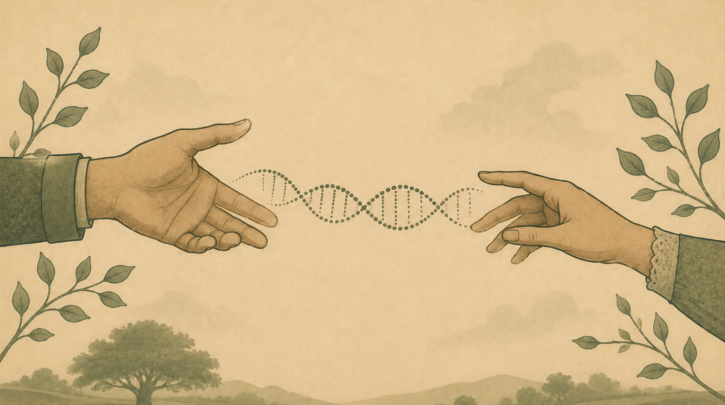

Somewhere in your match list is a stranger who keeps your great-grandmother’s photograph on their mantel. DNA testing’s real gift to Irish research is not the ethnicity pie — it is this: living relatives, findable in weeks, holding the memory the archives never collected.
Here is the working method for turning an Irish match list into actual relatives: reading the matches, clustering them into family lines, making contact across the Atlantic, and converting the connection into records.
Step One: Test Where the Relatives Are
Coverage first: AncestryDNA for the diaspora cousins, with the raw-data upload to MyHeritage adding the Ireland-and-Europe pool — the two-database strategy detailed in the head-to-head. Irish-line researchers fishing one pond catch half the family.
Step Two: Read the Match List Like a Researcher
- Shared centimorgans estimate the relationship: very roughly, second cousins share a couple of hundred cM, third cousins under a hundred — ranges overlap, so treat every figure as a band of possibilities, not a verdict.
- Shared matches sort the list into sides: the matches you share with a known paternal cousin are paternal-side; clusters of mutually-shared matches correspond to ancestral couples. Twenty minutes of clustering turns an undifferentiated list into four to eight family lines.
- Trees and surnames do the identification: within a cluster, hunt the documented trees and recognisable townland surnames — one match with a tree rooted in your candidate parish identifies the whole cluster’s line.
- Mind the Irish complication: centuries of marriage within small communities means distant Irish cousins can share more DNA than the tables predict — another reason clusters and paper outrank raw numbers.
Not sure which record to look for first?
Get the Irish Genealogy Starter Checklist — the ten records to find first, and exactly which free database holds each one.
Step Three: Identify Before You Write
The strongest first messages are written after the detective work: place the match against your tree using their visible tree, surnames, and locations, cross-checked against your documented chain and the sibling sets from the civil indexes. “I believe we connect through the Kellys of Cloonfad — your great-grandfather Thomas and my great-grandmother Mary were siblings” converts; “Hi, we share 87 cM, any ideas?” does not.
Step Four: The Message
- Lead with the named connection — people, places, one sentence, exactly as above.
- Offer before asking: a photograph, the tree, the emigrant’s story — you are bringing the lost half of a shared inheritance, and the framing changes everything.
- Keep ask one small: an exchange of family information — never records, hospitality, or further testing in the first message.
- Expect Irish response rhythms: replies arrive in days or in months, often after the message tours the family. The patience counsel of the living-relatives guide applies verbatim — and its letter-writing playbook is the same craft in another medium.
Step Five: Close the Loop Into Records
Every confirmed match is a research instrument: their branch’s certificates verify your chain, their townland knowledge aims the geography, their photographs caption yours — and their grandmother’s memory of “the American letters” may locate correspondence no archive indexed. Feed each confirmation back into the tree with its documentation; DNA proposes, paper disposes, and the combination is the proof.
Frequently Asked Questions
How much DNA do Irish relatives typically share with me?
Useful bands: a second cousin around 200–230 cM, a third cousin commonly 50–100 cM, a fourth cousin often under 35 cM and sometimes invisible — with wide overlaps throughout. The bands narrow candidates; shared-match clusters and documents identify them.
My closest matches are all in America — where are the Irish ones?
Mostly in the other database, or untested — Ireland tests at far lower rates than the diaspora. The MyHeritage upload usually surfaces the Irish and British matches; failing that, the staying line is found on paper and contacted directly.
Should I message a match with no tree and no surname?
After clustering, yes — place them by their shared matches first, then write the same named-connection message with “I believe” doing honest work. No-tree matches answer at lower rates but include the family historians who simply never built one online.
The Mantel Photograph
The records reunited the names; the matches reunite the people. Somewhere in the list, the photograph is waiting — write the message that earns the reply.
Want the shortcut? Grab the free Irish Genealogy Starter Checklist — the ten records to find first, and exactly which free database holds each one.