
Somewhere in Ireland, with reasonable probability, people share your great-grandparents and know things no archive holds — which field, which photographs, which version of the story is true. Finding them is the most human project in genealogy, and the one with the least method written down.
Here is the method: how to identify the stayed-behind line, locate its living end, make the approach without alarming anyone — and what to do when the answer is silence.
Step One: Find the Sibling Who Stayed
Living relatives descend from the emigrant’s siblings who remained — so the hunt starts in the records, not the phone book. Reconstruct the emigrant’s full sibling set via the parents-only search in the civil indexes, then identify which siblings appear in the 1901/1911 censuses still on the home ground — typically the one who inherited the holding. That sibling is the trunk of the living line.
Not sure which record to look for first?
Get the Irish Genealogy Starter Checklist — the ten records to find first, and exactly which free database holds each one.
Step Two: Walk the Line Forward
From the staying sibling, trace down the decades: their marriage and children in the civil records, the holding’s succession in the Griffith’s revision books, and then the twentieth-century traces — where the privacy thresholds close the registers, switch instruments: local death notices and obituaries (Irish ones famously list surviving relatives in full), parish memorial cards, townland memory, and the modern directories. The target is a name within living memory attached to the townland — “the Kellys still at Cloonfad” or the family that left it within recall.
Step Three: The Two Modern Shortcuts
- DNA matching — the great accelerant: a match list on the services strongest in Ireland surfaces the living line directly, sibling-set research optional. Method and tool choice in the DNA relative-finding guide and the testing comparison.
- The local network — the analog accelerant: county heritage centres, parish newsletters, local-history Facebook groups, and the townland’s farming neighbours, any of whom may complete in one message what records take months to suggest. A short, specific post — surname, townland, generation — in the right county group routinely produces cousins by the weekend.
Step Four: The Approach
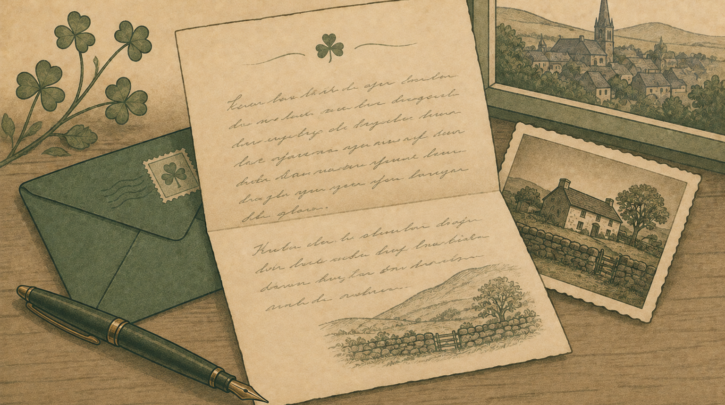
- Write first — letter or message, never a doorstep. Old-fashioned post to a townland address, with a return email, performs astonishingly well in rural Ireland.
- Lead with the shared people: “My great-grandmother was Mary Kelly of Cloonfad, who left for Boston in 1898; I believe her brother Thomas was your great-grandfather” — names, places, one sentence. You are offering a connection, not requesting a service.
- Enclose a photograph if you have one — the emigrant’s face is the single most door-opening artefact in this entire field.
- Ask small: an exchange of family information, perhaps a meeting if a trip is coming — not records, hospitality, or DNA, all of which may follow but none of which leads.
- Then allow time. Weeks, even months — rural correspondence has its own calendar, and the letter is frequently passed around the family before anyone replies.
When You Meet
Bring copies to give — the tree, the photographs, the certificates — and a notebook for the flood: the house, the graves, who-married-whom, the emigrant’s letters home if any survived (they sometimes did, in a drawer, waiting precisely for you). Record voices with permission. And mind the gradient: you arrive with documents, they hold memory — the exchange is the point, and the townland visit done together is its natural ceremony.
If the Answer Is Silence
Some letters go unanswered — wrong family, private people, or simply the drawer the letter waits in for a year. Send one gentle follow-up, then let it rest; meanwhile the parallel instruments (DNA, the county groups, the next branch sideways) keep working. Many reunions in this field happen on the second attempt, initiated from the other side, long after the first letter was “ignored.”
Frequently Asked Questions
How do I find relatives in Ireland if I only know the county?
You don’t yet — you find the townland first (the hunt), because the townland is what converts a county of strangers into a knowable set of neighbours and kin. Every step above assumes it; nothing replaces it.
Is it intrusive to contact unknown relatives out of the blue?
Done as above — written, specific, photograph enclosed, asking nothing — it is overwhelmingly received as a gift. Irish families largely know they have American (or Australian, or British) cousins somewhere; your letter answers a question they already had.
What if the family emigrated entirely and nobody stayed?
Then the living relatives are diaspora cousins — descendants of the other emigrant siblings — and DNA matching becomes the primary instrument, with the destination-country records as its check. The reunion is no less real for happening in Chicago instead of Clare.
The Archive That Answers Back
Records end where memory begins — and memory, unlike records, can pour you tea and correct your spelling of the townland. Write the letter.
Want the shortcut? Grab the free Irish Genealogy Starter Checklist — the ten records to find first, and exactly which free database holds each one.