
Dublin keeps its emigration story in a customs vault — fittingly — beneath the old CHQ building in the Docklands, where EPIC The Irish Emigration Museum tells the leaving of Ireland as a world story. Next door sits its quieter, more personal companion: the Irish Family History Centre, where the story being researched is yours.
Here is the visitor’s guide to both — what each does, how to use them together, and how to slot them into a heritage trip so they sharpen the rest of it.
EPIC: The Museum of the Leaving
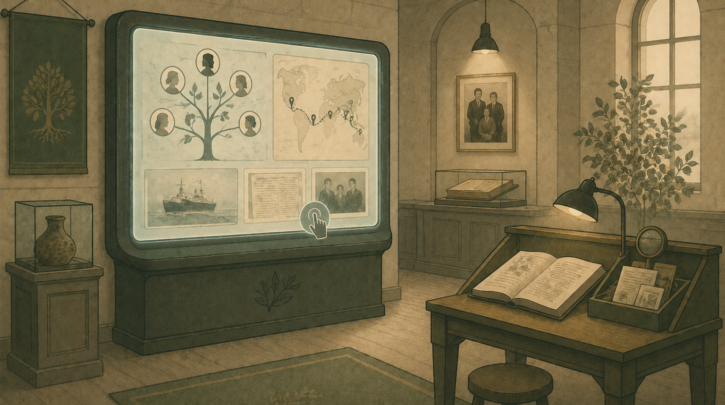
EPIC is a fully digital museum — twenty themed galleries of interactive screens, soundscapes, and motion rather than artefact cases — tracing why ten million people left the island and what they did across the world: the famine ships and the navvies, but also the writers, rebels, dancers, and the diaspora’s improbable global reach. It has collected armfuls of tourism awards and earns them; allow ninety minutes to two hours, and expect the “influence” galleries — where the emigrants’ descendants change the world — to be the part that ambushes you, since by definition that gallery is about your family.
The Irish Family History Centre: The Personal Annex
Attached to EPIC in the same building, the Irish Family History Centre is the practical counterpart: exhibits on how family research works, terminals for exploring the record databases — and, the real draw, bookable consultations with professional genealogists who will sit with your family information and work it live: assessing what you have, running targeted searches, and sending you away with next steps (and often with a townland candidate you arrived without).
Not sure which record to look for first?
Get the Irish Genealogy Starter Checklist — the ten records to find first, and exactly which free database holds each one.
Using the Consultation Well
- Book ahead — consultation slots are finite, trips are not flexible, and the early-trip slot is the valuable one.
- Bring the one-page summary: names, dates, places, and the brick wall stated plainly — the same sheet the trip guide has you carrying anyway.
- Aim the session at the trip: the highest-value question is geographic — “can we pin the townland?” — because the answer redirects your remaining days on the ground.
- Take the homework seriously: the searches they suggest map directly onto the free sources covered across this site — the civil indexes, the censuses, the registers.
Slotting Them Into the Trip
The canonical sequence: EPIC and the Centre on day one or two — the museum for the context, the consultation for the targeting — then the townland days with whatever the genealogist sharpened. The Docklands location makes it an easy half-day with the city’s other research institutions (the National Library and National Archives are a stroll and a Luas away for those with reading-room ambitions), and the CHQ building’s cafés handle the debrief. Travellers doing Ireland with mixed-interest companions, note: EPIC is the rare genealogy-adjacent stop the unconverted genuinely enjoy.
Frequently Asked Questions
Is EPIC worth it if I’ve already done my research?
Yes, differently — it supplies the context your certificates can’t: the scale and texture of the leaving your family was part of. Researchers tend to experience it as recognition rather than information, which is its own reward.
Can the Irish Family History Centre do my genealogy for me?
A consultation is targeting, not a commission — an expert hour that points your own research, with referral routes to fuller professional work if your case warrants it. For most visitors the hour plus the free databases is exactly the right dose.
How much time does the combined visit need?
Half a day comfortably: ninety minutes to two hours in EPIC, a consultation slot if booked, and browsing time in the Centre. Add hours, not minutes, if the reading rooms are calling.
The Story, Then Yours
EPIC tells the ten-million-person version; the Centre helps you find the one-family version; and the townland — where the trip is really headed — is where the two versions turn out to be the same story. See them in that order.
Want the shortcut? Grab the free Irish Genealogy Starter Checklist — the ten records to find first, and exactly which free database holds each one.