
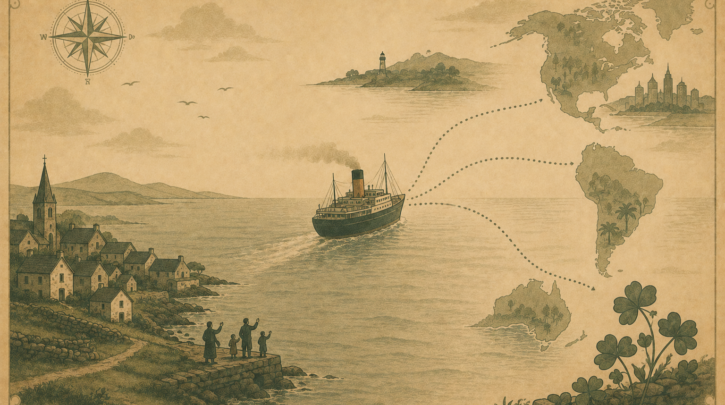

Ireland is the only country in Europe with fewer people today than in 1840. Hold that sentence a moment: famine, and then a century of leaving, so vast that the island never numerically recovered — while the leaving built an Ireland-beyond-Ireland of seventy or eighty million people. If you are reading this site, you are almost certainly one of them.
This is the story of the Irish diaspora — the waves, the reasons, the destinations, and the long turning of the tide that ends, perhaps, with you reading your great-grandmother’s townland off a screen.
The Scale of It
Roughly ten million people left the island of Ireland from 1800 onward — from a population that peaked near 8.5 million before the Famine and stood at half that a century later. No other European nation exported so large a share of itself. The result is the modern arithmetic: five million people in Ireland’s historic territory… and an order of magnitude more abroad who trace themselves to it.
Not sure which record to look for first?
Get the Irish Genealogy Starter Checklist — the ten records to find first, and exactly which free database holds each one.
The Waves
Before the Famine: the Ulster streams
The eighteenth century’s great leaving was largely northern and Presbyterian — the Ulster Scots (America’s “Scotch-Irish”) sailing from Derry and Belfast toward the American frontier, where their descendants would supply presidents and pioneers in improbable numbers. Catholic emigration ran thinner in this era: poorer, often seasonal, often only as far as Britain.
The Famine rupture, 1845–1852
Then the watershed — a million dead, well over a million fled in seven years, and the cultural transformation that mattered as much as the numbers: emigration changed from misfortune to expectation, the thing an Irish family raised some of its children to do. The Famine’s own story, and what its records mean for researchers, has its own chapter.
The long haemorrhage, 1850s–1920s
The post-Famine decades institutionalised the leaving: chain migration, passage money folded into letters home, the “American wake” held for the living because the parting was reckoned permanent. Inheritance customs consolidated farms onto single sons — everyone else’s future lay abroad — and whole townlands replicated themselves in Boston wards and Pennsylvania patches. This is the era most readers’ ancestors travelled, and the era the manifests document best.
The twentieth century: the boat to Britain
Independent Ireland kept leaving — but the destination swung to Britain: the post-war rebuilding of English cities was substantially Irish-handed, and the 1950s drained the countryside again. The pattern only inverted within living memory, when the boom decades made Ireland, astonishingly, a country of immigration — the tide’s first true turn in two centuries.
Where They Went
- The United States — the headline destination: the famine cities of the east becoming the Irish-American world of parishes, police, politics, and eventually the suburbs; tens of millions claim the descent today.
- Britain — the constant: nearest, cheapest, and for many eras the largest stream — the diaspora’s least romanticised and most numerous branch.
- Canada — massive famine-era arrivals through Quebec and Saint John, and an Ulster-flavoured settlement of Ontario.
- Australia and New Zealand — convicts first, then assisted passages by the shipload; roughly a third of Australians claim some Irish descent, the highest proportion outside Ireland.
- Argentina — the unexpected chapter: a substantial nineteenth-century Irish community on the pampas, Westmeath and Longford accents among the gauchos.
What the Diaspora Sent Back
The leaving ran on a counterflow: remittances that paid rents and passages, the “American letter” read aloud in the kitchen, and eventually the political money and pressure that shaped Irish independence from afar. The emigrants’ relationship with home was never severance — it was a long-distance household, which is precisely why the records and the memories on both shores interlock the way researchers find they do.
The Tide Turns
And the present chapter: the descendants coming back — as visitors walking the townlands, as researchers reuniting the split families, and in rising numbers as citizens, through the descent provisions Ireland built specifically to keep faith with its scattered millions. The diaspora was never an ending; it was the longest round trip in modern history, and the return leg is being flown now.
Frequently Asked Questions
How many people make up the Irish diaspora?
The standard estimate runs to seventy or eighty million people of Irish descent worldwide — against roughly seven million on the island — with the United States, Britain, Australia, and Canada holding the largest shares.
Why did so many Irish people emigrate?
The compounding push of land hunger, rent, and famine against the pull of wages and passage money already sent — then, after 1850, the self-sustaining machinery of chain migration and inheritance customs that budgeted most children for export. Catastrophe started the flood; economics institutionalised it.
Was the diaspora all Catholic?
No — the earliest great wave was largely Presbyterian Ulster, and Protestant emigration continued throughout; the post-Famine flood was predominantly Catholic. The diaspora reproduces the island’s whole complexity, which is worth remembering when the records surprise you.
Your Line in the Ledger
Ten million departures, and one of them is yours — a specific person, on a findable manifest, from a recoverable townland. The history above is the context; the method is how you find your family’s line in it.
Want the shortcut? Grab the free Irish Genealogy Starter Checklist — the ten records to find first, and exactly which free database holds each one.