
Three letters — O’, Mc, Mac — carry most of the folklore in Irish naming, and most of the misinformation. No, Mc is not Irish while Mac is Scottish. No, the apostrophe is not possessive. And the great-grandfather who “dropped the O” was making a decision with two centuries of history behind it.
Here is what the prefixes actually mean, why they vanished and returned, and what their presence or absence on your records does — and does not — signify.
The Grammar: Ó and Mac
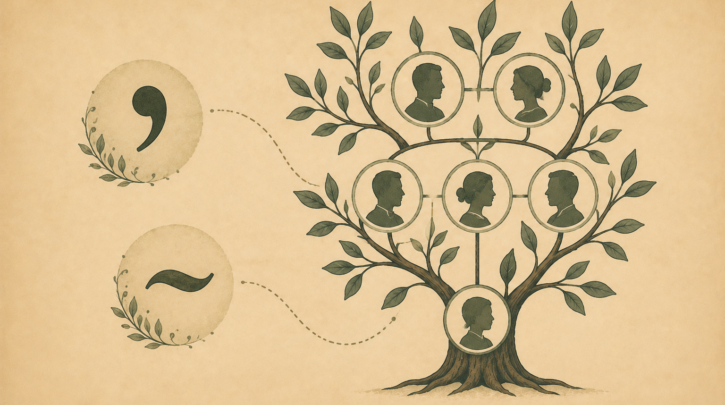
In Irish, surnames are grammatical phrases. Ó (older spelling Ua) means grandson or, loosely, descendant: Ó Briain, descendant of Brian. Mac means son: Mac Carthaigh, son of Cárthach. The anglicised O’ is simply Ó wearing an apostrophe the English alphabet insisted on — it marks the lost fada, not possession — and Mc is nothing but a scribal abbreviation of Mac: same word, shorter pen-stroke, zero significance in the difference. Families and even siblings alternated Mc/Mac freely; treat them as one prefix when searching.
Not sure which record to look for first?
Get the Irish Genealogy Starter Checklist — the ten records to find first, and exactly which free database holds each one.
The Feminine Forms Nobody Told You About
Traditional Irish never gave a woman her father’s masculine prefix: a daughter of Ó Briain was Ní Bhriain (“daughter of the descendant”), a daughter of Mac Carthaigh was Nic Carthaigh, and wives took Uí / Mhic forms. Anglicisation flattened all of this to the male form for everyone — but the feminine prefixes survive in Irish-language records, Gaeltacht families, and the modern revival, and recognising Ní/Nic as “same family, female form” saves real confusion in Irish-language sources.
Fitz: The Norman Cousin
Fitz- (Norman-French fils, son) is the invader’s Mac: FitzGerald, FitzMaurice, FitzPatrick — that last one a fascinating hybrid, a Gaelic royal line (Mac Giolla Phádraig) that translated itself into Norman dress. Fitz names belong to the Norman layer and are as Irish as eight centuries can make anything.
The Great Disappearance
From the seventeenth century through the Victorian era, the prefixes fell away wholesale — under the Penal-era disadvantages of conspicuous Gaelic identity, the practical pressures of dealing with English-speaking administration, and eventually plain fashion, as prefix-less names came to read as modern and respectable. By the mid-nineteenth century the bare forms dominated: Connor, Brien, Sullivan, Neill. For researchers the consequence is absolute: every record search must run with and without the prefix, because the same man is O’Brien at baptism, Brien in Griffith’s, and O’Brien again on his daughter’s certificate.
The Great Return
The Gaelic revival of the late nineteenth and early twentieth centuries sent the prefixes marching back — families resumed the O’ and Mac as statements of identity, and the restoration accelerated after independence. The return was uneven: O’ came back more strongly than Mac in some names, some families never resumed (plenty of Connors and Sullivans simply stayed), and emigrant branches often kept the bare form their ancestor carried out of Ireland while the home branch re-prefixed. Two cousins, two surnames, one family — a pattern worth expecting rather than puzzling over.
What the Prefix Tells the Researcher
- Its absence means nothing about origins: a prefix-less Sullivan is exactly as Gaelic as an O’Sullivan — the drop was historical weather, not lineage.
- Its presence on old records is a search key, not an identity: index entries split between prefixed and bare forms — the variant checklist runs both, always.
- The resumption can date itself: a family appearing as Brien in 1860s records and O’Brien by 1911 is exhibiting the revival in real time — useful corroboration that two record-sets show one family.
- Mc vs Mac distinguishes nothing: not nationality, not religion, not family — index both spellings and move on.
Frequently Asked Questions
What does O’ mean in Irish surnames?
It is the Irish Ó — grandson or descendant of — pointing at the early-medieval ancestor whose name follows. O’Brien: descendant of Brian. The apostrophe is an English-orthography artefact standing in for the accent, not a possessive.
Is Mc Irish and Mac Scottish?
No — both occur abundantly in both countries, because Mc is merely an abbreviation of Mac. Scotland’s Gaelic naming shares the same word; the prefix cannot sort Irish from Scottish names, though the name that follows it often can.
Why did my family drop the O’ — and should records before and after match?
They dropped it with most of Gaelic Ireland, under centuries of administrative and social pressure; some line of yours may or may not have rejoined the revival-era resumption. Expect the records to disagree across the nineteenth century — the disagreement is the period’s signature, not an error in your research.
Can I resume the prefix myself?
Families have been doing exactly that for a century — it is restoration, not invention. For research purposes keep working both forms regardless; for the name on your letterbox, the O’ your great-grandfather set down is yours to pick back up.
Small Words, Long Memory
The prefixes compress the whole national story — Gaelic grammar, conquest-era camouflage, revival-era pride — into the first syllable of a name. Decode the rest of yours with the surname origins primer, and then put the variants to work in the research workflow.
Want the shortcut? Grab the free Irish Genealogy Starter Checklist — the ten records to find first, and exactly which free database holds each one.