
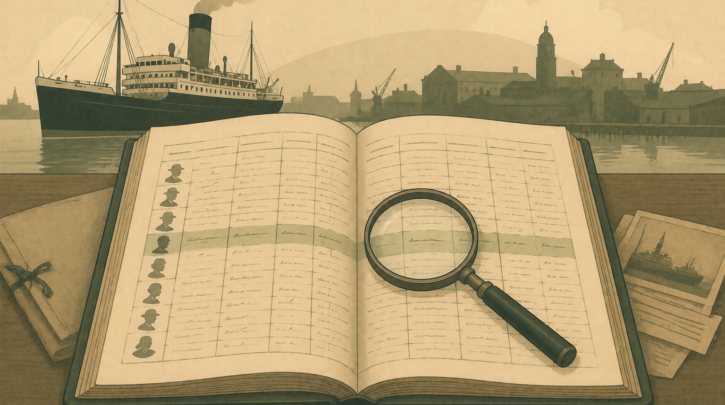

Between the Famine and the founding of the Free State, Ireland exported people on a scale no European nation has matched — millions of departures, most of them one-way. The paradox for researchers: the country they left kept almost no record of their going. The countries that received them, however, wrote nearly everything down.
This guide maps the emigration paper trail: which records exist for which eras, why the arrival side beats the departure side, and how a single manifest line can hand you the townland three other record classes refused to give up.
The First Rule: Search Arrivals, Not Departures
Ireland and Britain kept sparse outbound passenger documentation for most of the emigration century — systematic outbound lists are a late development. The receiving countries, by contrast, inspected, listed, and filed. So the working method is always the same: identify the destination, then search that country’s arrival and immigration records. The Irish end of the trail is reconstructed from the foreign end.
Not sure which record to look for first?
Get the Irish Genealogy Starter Checklist — the ten records to find first, and exactly which free database holds each one.
The Eras, and What Each Left Behind
Pre-Famine (before 1845)
The thinnest era: early US customs passenger lists exist from 1820 but record little (name, age, occupation, country). Canadian and Australian arrival material is patchy; assisted-emigration and estate-clearance schemes left some of the best lists, where they survive. Pre-famine emigrants are found more often through their later records — naturalisations, church marriages, obituaries — than their crossings.
The Famine exodus (1845–1852)
Vast volume, minimal detail: famine-era manifests typically give name, age, and “Ireland” — the genealogical equivalent of a shrug. The compensating sources are on land: Boston and New York church records, almshouse and hospital admissions, and the missing-friends newspaper columns through which scattered families sought each other — advertisements that often name the home parish precisely because that is how Irish people identified one another.
The chain-migration century (1850s–1920s)
The researcher’s golden era. Manifests grow steadily more detailed, and from the early twentieth century they answer the exact questions you are asking: last permanent residence, and the name and address of the nearest relative in the country whence the alien came — very commonly a parent, at the home townland. A 1907 manifest line reading “Father: John Kelly, Cloonfad, Co. Roscommon” is the townland breakthrough delivered whole.
The Ports and Their Records
- Cobh (Queenstown), Cork: the iconic departure point — emigrants appear in the arrival lists of wherever the liner landed.
- Liverpool — the hidden middle: an enormous share of Irish emigrants crossed to Liverpool first and embarked there; an ancestor “from Liverpool” on a manifest is very often Irish one step earlier. Some stayed years in Britain before the Atlantic leg — check English censuses for the pause.
- Derry and Belfast: the northern streams, heavily represented in Canadian and US arrivals from Ulster.
- Castle Garden, New York (1855–1890), and the customs lists before it: the pre-Ellis arrival record for the port that received most famine and post-famine Irish — searchable free.
- Ellis Island (1892–1957): the detailed-manifest era for New York — free to search, with images; the nearest-relative and last-residence columns are the prize.
- Boston, Philadelphia, Baltimore, New Orleans; Quebec and Saint John; Sydney and Melbourne: each with its own arrival series — never assume New York.
Australia’s Paper Bonus
Assisted-passage emigration to Australia generated the best emigrant records in the Anglophone world: applicants for subsidised passages supplied parents’ names, native place, age, religion, and references — whole genealogies on one form. If any branch of the family went south, their assisted-immigration file may document the Irish origins for every branch, including yours.
Where to Search
The free pillars: Ellis Island and Castle Garden’s own databases, and the National Archives systems of the destination countries. The subscription giants earn their fees here more than anywhere — Ancestry for the deepest US arrival and naturalisation collections, Findmypast for Irish and British departure-side material and newspapers, MyHeritage for cross-matching the scattered branches. Pair every manifest find with the naturalisation file it predicts — the petition repeats and sharpens the manifest’s geography — and feed the result straight into the townland hunt.
Reading a Manifest Line Like a Researcher
- Confirm identity on the cluster, not the name: age, accompanying family, and the contact names — not the spelling, which was written by a clerk at speed.
- Harvest every column: who paid the passage, the destination contact (“going to brother, Michael Kelly, 14 D Street, South Boston” — a sibling located), the last residence, the nearest relative at home.
- Note companions on adjacent lines — chain migration travelled in cousin-clusters, and the neighbour on the manifest is often a neighbour from the townland.
- Cross the find against the civil records and the 1901/1911 censuses — the family that stayed verifies the family that left.
Frequently Asked Questions
Where can I find passenger lists of ships leaving Ireland?
Mostly, you can’t — systematic outbound lists were not kept for most of the era, which is why the method runs through arrival records abroad. Where departure-side material exists (later Board of Trade lists, some port collections), the subscription services index it; the arrival record remains the reliable spine.
Did Ellis Island officials change immigrants’ names?
No — the durable myth. Manifests were compiled at the port of departure from tickets and documents; inspectors checked names against the existing list rather than inventing new ones. The real renaming happened before departure (agents, clerks) and after arrival (self-anglicisation for work and fitting in) — the mechanisms unpacked in the anglicisation guide.
My ancestor “arrived about 1880” — how do I find the ship?
Bracket and filter: the 1900 US census asked immigration year (take it as ±3), naturalisation papers often state ship and date outright — find those first — then search the arrival indexes on name variants within the bracket, filtering by age and Irish origin. The naturalisation-first route is nearly always faster than brute-forcing manifests.
What if my ancestor went to Britain rather than America?
Britain kept no inbound record of Irish arrivals — the Irish were internal migrants within one state. The compensations: English and Scottish censuses every decade (birthplace: Ireland, sometimes with county), civil registration from 1837, and Catholic parish records in the industrial cities — a different toolkit, often a richer one.
The Crossing Was the Hinge
Every diaspora family’s story folds at the crossing — one document set on each side of the Atlantic, joined by a manifest line. Find the line, and the two halves of the research — and of the family — reconnect. Then go read about why they left in such numbers; the records make more sense once the history does.
Want the shortcut? Grab the free Irish Genealogy Starter Checklist — the ten records to find first, and exactly which free database holds each one.