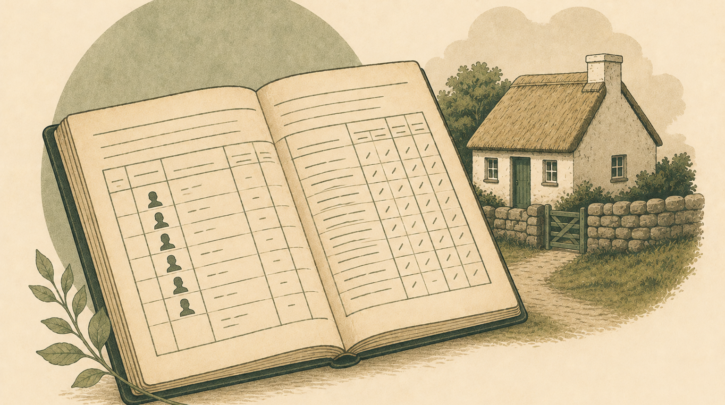

Two snapshots survive of every household in Ireland: Sunday night, 31 March 1901, and Sunday night, 2 April 1911. Everything the nineteenth century counted before that is gone — which makes these two census years not just useful but precious, and mercifully, completely free.
This guide shows how to search the 1901 and 1911 censuses, what every column actually means, the famous 1911 questions that crack brick walls, and how to wring conclusions from the gap between the two years.
Why Only Two Years Survive
Ireland counted its people every decade from 1821 — and then lost the returns: the 1861–1891 censuses were destroyed by government order (some pulped during the First World War paper shortage), and most of 1821–1851 burned with the Public Record Office in 1922. The 1901 and 1911 returns, still in administrative custody at the time, escaped — the full story is in the 1922 guide. The National Archives has published both surviving years free, images and index, at census.nationalarchives.ie.
Not sure which record to look for first?
Get the Irish Genealogy Starter Checklist — the ten records to find first, and exactly which free database holds each one.
What the Forms Record
- Form A — the household return: every person present that night, with name, relation to the household head, religion, literacy, age, sex, occupation, marital status, county (or country) of birth, ability to speak Irish, and specified disabilities.
- The 1911 bonus questions: married women were asked years of present marriage, children born alive, and children still living — three numbers that compress a family’s whole story (and its griefs) into one line, and date a marriage you have not yet found.
- Forms B1/B2 — the buildings: house class, walls, roof, rooms, outbuildings — the texture of how the family actually lived, from one-room cabin to slated farmhouse.
Search Strategy
- Start at 1911 and work back to 1901 — the later year’s extra questions identify the family more firmly, and the decade’s changes then read backward naturally.
- Search loose: surname plus county returns manageable lists; forename initials beat full forenames; and ages lie — pad every range, because the same man is routinely 38 in 1901 and 52 in 1911.
- Use the townland browse when names fail: the entire census is browseable by county → district → townland, so a known townland (from a civil birth record) lets you read the whole townland’s households — finding the family the index mangled, and meeting the neighbours, who are never irrelevant.
- Always open the original image: the household filled the form in their own hand (or the enumerator’s) — spelling, signatures, and the Irish-language column as the family themselves declared it.
Reading Between the Two Years
The 1901–1911 comparison is its own research method. A daughter present in 1901 and absent in 1911 has married locally (search the civil marriage indexes) or emigrated (search the manifests). A new surname in the household is a marriage; a missing parent is a death registration waiting to be found; the 1911 children-born/children-living gap names the infant deaths the family never spoke of. And the household head’s farm passing from father to son between the years dates the succession that the land records will confirm.
The Emigrant’s-Eye View
For diaspora researchers the censuses serve a specific purpose: they document the family that stayed. Your emigrant ancestor left before 1901? Their parents and siblings are in these returns — the home townland, the brother on the farm, the ages that calibrate every birth estimate. That residual family is the bridge: it confirms you have the right townland before you order certificates, and it is the line that leads to living relatives today. Cross-reference with the civil records constantly — censuses propose, registrations confirm.
Quirks and Cautions
- The 1911 age inflation: the Old Age Pension (introduced 1908, payable at 70) inspired remarkable ageing between censuses — treat 1911 ages of the elderly as negotiating positions.
- “Cannot read” tells you about records, not intelligence: an illiterate household’s names were spelled by the enumerator — expect variants.
- Religion column courtesy: recorded as declared — useful for choosing which church’s registers to search next.
- Present, not resident: the census counts who slept there that night — a son working away appears in his lodgings, not the home place.
Frequently Asked Questions
Are the Irish censuses really free?
Completely — images, indexes, and browsing, on the National Archives site, no account required. They are among the most generously published census records anywhere.
Is there anything to substitute for the destroyed nineteenth-century censuses?
The substitutes are the point of two whole record classes: Griffith’s Valuation (1847–1864) for the mid-century and the Tithe Applotment books for the 1820s–30s — both household-head surveys rather than full censuses, both indispensable. Surviving census fragments for some counties and years also exist and are searchable.
Why can’t I find my family in 1901 when I know they were in Ireland?
Index mangling, an unexpected townland, or a border-of-district registration habit, usually. Switch to the townland browse from a known address, rotate surname variants, and check the neighbouring district — the family is almost certainly on a page the search box cannot see.
What does the Irish-language column actually indicate?
Self-declared ability — “Irish” or “Irish and English.” In western counties it maps real bilingual communities; the column is also quiet social history, often showing the grandparents Irish-speaking and the children not.
Two Nights, Whole Families
Spend an evening with each census year and the certificates on your desk become people in rooms — counted, occupied, declaring their literacy and their language to an enumerator a century ago. Then take the townland from the form to Griffith’s and watch the same family appear a generation earlier on the land.
Want the shortcut? Grab the free Irish Genealogy Starter Checklist — the ten records to find first, and exactly which free database holds each one.