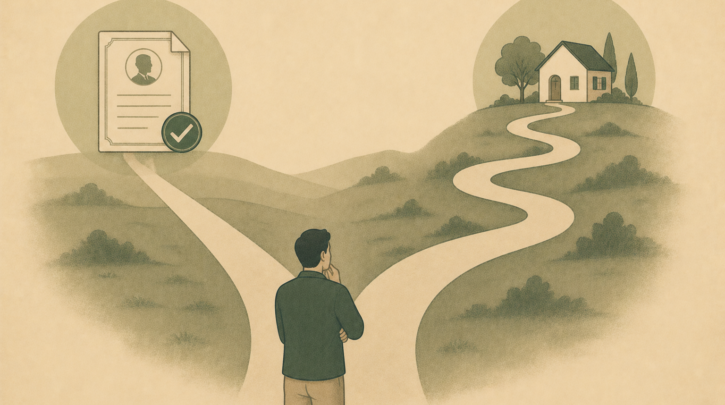

Two roads lead to the same harp-embossed passport: prove who your grandmother was, or live in Ireland long enough to belong. They could hardly be more different journeys — and choosing the right one (or realising only one is open to you) is worth ten minutes of clear comparison.
This guide sets descent and naturalisation side by side: requirements, costs, timelines, and the less obvious differences that decide real cases.
The Two Routes in One Paragraph Each
Citizenship by descent is an entitlement based on ancestry: a parent born in Ireland makes you a citizen automatically, and an Irish-born grandparent entitles you to register on the Foreign Births Register. No residence, no language test, no discretion — documents prove the chain and citizenship follows. The full mechanics live in the complete descent guide.
Naturalisation is the residence route: broadly five years of reckonable residence in Ireland within the previous nine (with the final year continuous), good character, an intention to remain, and a discretionary grant by the Minister for Justice. Spouses of Irish citizens use a gentler variant — three years of residence — and a separate discretionary strand exists for people of Irish descent or associations.
Not sure which record to look for first?
Get the Irish Genealogy Starter Checklist — the ten records to find first, and exactly which free database holds each one.
Side by Side
- Who it serves: descent serves the diaspora abroad; naturalisation serves people actually building lives in Ireland. The first question is simply which describes you.
- Certainty: descent is entitlement — prove it and it cannot be refused. Naturalisation is discretion — conditions met, the grant is still the Minister’s to make, though refusals of qualified applicants are not the norm.
- Residence: none whatsoever for descent. Years of physical presence, documented, for naturalisation — with absences accounted.
- Cost: descent runs a few hundred euro all-in. Naturalisation’s application and certification fees are substantially higher, before counting the implicit cost of the residence itself.
- Timeline: descent: twelve to eighteen months of process you mostly wait through abroad. Naturalisation: the years of residence first, then a processing period that has commonly run one to two further years.
- What passes to children: both create citizens whose later-born children can register through them — the chain logic applies from the date citizenship begins, whichever door it came through.
The Cases Where the Choice Is Real
Most readers have no choice to make — their ancestry either qualifies or it does not. The genuinely strategic cases:
You qualify by descent and live in Ireland anyway
Register by descent — it is cheaper, certain, and the years-of-residence ledger becomes irrelevant. There is no scenario where a descent-eligible person is better served by naturalising.
Your descent chain is broken but you can move
The great-grandchild whose parent never registered — the closed-chain case — sometimes holds EU citizenship through another line, a remote-work income, or simply the will to emigrate. Five years of Irish residence rebuilds by naturalisation what the registration calendar closed by descent, and the Irish-associations discretionary strand may shorten the road for the genuinely connected.
You married into Ireland
Marriage confers no citizenship by itself, but the spousal naturalisation track’s three-year residence requirement is the law’s recognition of the relationship. Note that the residence must still happen — a spouse abroad accrues nothing.
Documents vs Diary: How the Proof Differs
Descent applications are archaeology — certificates assembled from registries, as catalogued in the FBR document checklist. Naturalisation applications are accountancy — residence permissions, tax records, employment history, and a character assessment, compiled from your own recent life. People who flinch at one kind of paperwork are often soothed by the other; neither is harder, they are merely different muscles.
Frequently Asked Questions
Is citizenship by descent “better” than naturalisation?
The citizenship is identical — same passport, same rights, same heritability. The routes differ in price of admission: descent costs paperwork, naturalisation costs years of residence plus higher fees plus discretion. Where both are genuinely available, descent wins on every practical axis.
Can time spent in Northern Ireland count toward naturalisation?
Naturalisation residence is reckoned in the State — the Republic. Northern Ireland matters enormously to descent claims (island-of-Ireland births qualify) but does not bank residence for a Republic naturalisation application.
Does a descent application require living in or even visiting Ireland?
Never. The Foreign Births Register is designed for applicants abroad — documents travel, you do not. Plenty of new citizens meet Ireland for the first time on the passport they earned from five thousand miles away.
I’m eligible for descent but my spouse is not — what is their path?
Your registration first, then either the spousal naturalisation track (three years’ residence in Ireland as your spouse) or EU free-movement family rights if you exercise your citizenship elsewhere in the Union. Their road runs through your certificate — another argument for starting it now.
The Numbers, Side by Side
- Descent — money: FBR fee around €270–€300, plus certificates, witnessing, and shipping — a realistic all-in of €500–€800, with the passport fee on top.
- Descent — time: one to three months of your effort, then nine to twelve months of queue: call it twelve to eighteen months elapsed, almost none of it demanding anything from you.
- Naturalisation — money: a higher application fee plus a substantially larger certification fee on approval — budget well in excess of €1,000 in State fees alone for an adult, before any professional help.
- Naturalisation — time: the five qualifying years (three for spouses) come first and cannot be compressed; processing after application has commonly added a year or more on top. The honest planning horizon is the better part of a decade from a standing start.
- Risk profile: a complete descent file has essentially one outcome. A naturalisation file meets a discretionary decision — favourable in the strong majority of qualified cases, but a different kind of wait.
Reckonable Residence: The Fine Print That Decides Cases
Naturalisation’s “five years” is five years of reckonable residence — and not every lawful day in Ireland counts. Periods on certain permissions (historically including time as a student, and time awaiting asylum decisions) have been excluded from the reckoning in whole or part, absences are deducted against continuity rules, and the final year before applying carries its own continuous-residence requirement with limited allowable absence. None of this is exotic — but it means two people with identical Irish years can stand years apart in eligibility. Anyone building a naturalisation plan should reconcile their permission history against the current reckoning rules early, because discovering a non-reckonable year at application time is the route’s signature heartbreak.
The Decision, As a Flowchart in Words
- Parent born on the island of Ireland? You are a citizen already — passport application, done.
- Grandparent born on the island? Descent via the FBR — start here, and read no further.
- Great-grandparent, with a parent registered before your birth? Still descent — the chain case.
- Married to an Irish citizen and willing to live in Ireland? Spousal naturalisation — three reckonable years.
- Real, demonstrable Irish associations beyond ancestry? The discretionary associations strand — eyes open about the odds.
- None of the above, but Ireland is the plan anyway? Standard naturalisation — five reckonable years, and the warmest possible version of the long way around.
Choose the Door That’s Open
For nine readers in ten, this comparison ends where it began: if an Irish-born parent or grandparent stands in your tree, the descent route is open, certain, and waiting — start with the eligibility pathways and then the application guide. For the tenth reader, naturalisation is not a consolation prize; it is how Ireland welcomes the people who choose her without the ancestry — a slower road to the very same harp.
Not sure if you qualify? Work through every pathway in the Eligibility Guide.