
It is the hardest conversation in Irish citizenship: a great-grandmother from Tipperary, a family fiercely proud of its Irish roots — and a legal rule that usually says no. Usually. Not always.
This guide gives you the honest picture of the great-grandparent route: the one scenario where it genuinely works, the discretionary fallback and its real odds, and what to do with your Irish identity when the passport route is closed.
The Rule, Stated Plainly
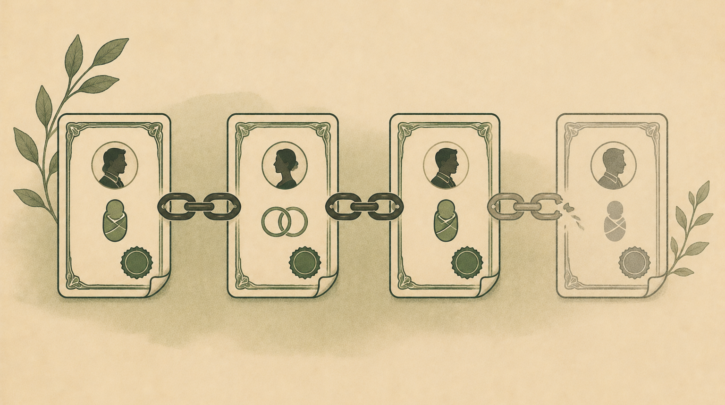
Irish citizenship by descent through registration reaches reliably to grandchildren of the Irish-born. Great-grandchildren can register on the Foreign Births Register only if their parent was registered on the FBR before they were born. The entitlement chains forward through registration — each generation must register before producing the next claiming generation.
That single sentence sorts most readers into two groups, so check it first: did your parent (the grandchild of the Irish-born ancestor) ever register on the Foreign Births Register? And if so, was it before your birth?
Not sure which record to look for first?
Get the Irish Genealogy Starter Checklist — the ten records to find first, and exactly which free database holds each one.
Scenario 1 — Your Parent Registered Before You Were Born
You are entitled to register, exactly as if you held the grandparent connection yourself. Your document chain adds one generation — your parent’s FBR certificate joins the bundle — but the process is otherwise the standard FBR application. And note the gift you can pass on: register before your own children are born and the chain continues to them.
Scenario 2 — Your Parent Registered After You Were Born
Painful but clear: their registration made them Irish from that date forward, and only children born after that date inherit the entitlement. Younger siblings born after the registration may qualify while you do not — a genuinely strange family outcome the law produces regularly.
Scenario 3 — Your Parent Never Registered
The registration door is closed at your generation. Two paths remain — one discretionary, one practical:
Naturalisation by Irish associations
Irish law allows the Minister for Justice to waive the normal naturalisation conditions for applicants of Irish descent or Irish associations. Published guidelines shape the decisions, and successful applicants typically show more than ancestry alone: demonstrated, continuing connection to Ireland — time spent there, family ties, community involvement. Approval rates are modest and the process is slow and fee-bearing. It is a genuine route for genuinely connected applicants, and a poor bet for a paper-only claim.
Could your parent register now?
Here is the angle families miss: if your parent still qualifies through their grandparent (your great-grandparent), they can register today. It will not confer citizenship on you — the before-birth rule stands — but it makes your parent an EU citizen, and it resets the chain for any children born to your siblings or cousins after their own future registrations. Family strategy sometimes beats individual strategy.
Questions to Answer Before You Decide Anything
- Did your parent ever register on the FBR — and on what date? Ask directly, then verify; people forget paperwork from decades ago, and an old certificate in a drawer has settled more than one family’s question.
- Is your parent still living and themselves eligible? If their qualifying ancestor is their grandparent, their own registration is available today — with consequences for births after it.
- How real are your Irish associations, honestly? Count the visits, the relationships, the memberships, the months. If the list is aspirational rather than historical, build it before filing anything discretionary.
- What is the goal underneath the passport? EU work rights have other doors (employer sponsorship, other ancestries in your tree, residence routes). Heritage connection has many. Naming the actual goal often reveals a better path to it.
Planning for the Next Generation
Whatever route eventually makes you Irish — chain registration or naturalisation by associations — the inheritance logic restarts with you: children born after you become a citizen can claim through you, and the FBR chain can run forward from there indefinitely, registration by registration. Families who internalise this plan differently: the question stops being “can I get the passport?” and becomes “which living family member’s registration, done now, keeps the line open for everyone after them?” Sometimes the right applicant in the family is not the person reading this page — it is their mother.
Why Ireland Drew the Line at Grandchildren
It helps to understand that the line is a choice, not an accident. Ireland’s diaspora is enormous relative to its population — tens of millions of people hold some Irish descent — and an unlimited descent rule would make the citizen register a genealogical database rather than a civic one. The grandparent boundary, with chain registration as the extension mechanism, is Ireland’s compromise: generous enough to keep faith with the emigrant generations, bounded enough to keep citizenship meaningful.
The comparison with Italy is instructive. Italy ran a near-unlimited descent rule for decades — any ancestor alive after unification could anchor a claim — until application volumes overwhelmed the system and a 2025 reform abruptly cut eligibility to two generations, stranding hundreds of thousands of would-be applicants mid-research. Ireland’s narrower-but-stable rule has never produced that cliff. The lesson for anyone currently eligible, in either system: rules that feel permanent are political, and the entitlement you hold today is worth more than the one you plan to claim someday.
The Three Scenarios as Real Families Live Them
The chain-registration rule produces family outcomes that feel arbitrary until you see the date logic underneath:
- The far-sighted line: a Chicago grandfather registers on the FBR in 1968 on the strength of his Mayo-born father. His children, born in the 1970s, inherit the entitlement and register in the 1990s; their children inherit it too. Four generations from Mayo, every one of them Irish — because each registered before the next was born.
- The split siblings: a mother registers in 2010. Her daughter born 2012 is entitled; her son born 2008 is not. Same parents, same great-grandmother from Donegal, different sides of one administrative date.
- The closed line: nobody in three generations ever heard of the FBR. The great-grandchildren discover it on a heritage trip — and discover, in the same week, that the registration era for their line ended a generation ago.
Building a Credible Associations Case
If the discretionary route is your only door, treat it like the discretionary application it is. The published guidance and decided cases reward applicants who can show Ireland is part of their life, not just their lineage:
- Time in Ireland: repeated visits, periods of residence, study at an Irish institution — documented with dates.
- Living family ties: relationships with relatives in Ireland, maintained and evidenced, carry real weight.
- Community connection: sustained involvement in Irish cultural, sporting, or community organisations — years of membership, not a sign-up receipt.
- The genealogical foundation: a professionally clean documentary chain to your Irish ancestor, exactly as if you were FBR-eligible — discretion is exercised on proven facts.
Applicants with two or three of these pillars, built over years, have a case worth filing. Applicants with a DNA pie chart and enthusiasm generally do not — and the kindest thing this guide can do is say so before the fee is paid.
If the Passport Route Is Closed, the Heritage Is Not
Citizenship law measures registration dates; identity runs deeper. The same great-grandmother who falls one generation outside the FBR rules is fully within reach of your research — tracing her records, finding her townland, and standing where she stood ask no minister’s permission.
Frequently Asked Questions
Is there any direct great-grandparent route without prior registration?
Through entitlement-based registration, no. Naturalisation by Irish associations is the only door, and it is discretionary, guideline-bound, and granted sparingly.
What exactly counts as “Irish associations”?
The statutory definition centres on relation by blood, affinity, or adoption to an Irish citizen (or a person entitled to be one). In practice the published guidelines look for substantive connection to Ireland beyond the family tree itself — the applicants who succeed tend to have lived links, not just lineage.
My great-grandparent route failed — should I pay a solicitor to try anyway?
Pay for an hour of honest assessment, not for a hopeless application. A good practitioner will tell you quickly whether your associations case has substance — here is how to choose one and what it should cost.
Does DNA evidence of Irish ancestry help an associations application?
Ethnicity percentages carry no legal weight. Where DNA genuinely helps is genealogical: confirming the family connections behind your documentary chain and locating Irish relatives whose records strengthen the file.
How long does a naturalisation-by-associations application take?
Materially longer than the FBR — discretionary naturalisation files move through a different ministry at a different pace, and waits measured in years rather than months are normal. Factor that into the comparison honestly: a parent’s straightforward FBR registration today may serve the family’s next generation faster than your own discretionary application serves you.
Does marrying an Irish citizen change my position?
It opens the spousal naturalisation track — a shorter residence requirement than standard naturalisation — but residence in Ireland remains the price of admission. Marriage confers no automatic citizenship and does not interact with the descent rules at all; your great-grandparent chain is what it is regardless of whom you marry.
The Honest Bottom Line
If your parent registered before your birth: congratulations, proceed to the standard application. If not: weigh the associations route only if your connection to Ireland is real and demonstrable — and either way, claim the heritage. That part was never the government’s to grant.
Not sure if you qualify? Work through every pathway in the Eligibility Guide.